Affichage des articles dont le libellé est PLA. Afficher tous les articles

vendredi 6 juillet 2012

US bioplastics demand to exceed 550M lbs in 2016


US demand for bioplastics is forecast to climb at a 20 percent annual pace through 2016 to 550 million pounds, valued at $680 million.  Although they have achieved a considerable degree of commercial success, bioplastics remain in an early stage of development, representing only a small niche within the overall plastics industry.  Going forward, technical innovations that enhance the properties of bioplastics and lower their price will drive growth.  These and other trends are presented in Bioplastics, a new study from The Freedonia Group, Inc., a Cleveland-based industry market research firm.

Although biodegradable resins accounted for the vast majority of bioplastics volume in 2011, the emergence of non-biodegradable bioresins will dramatically alter the market landscape going forward.  By 2021, these materials will represent more than two-fifths of volume demand, up from 13 percent in 2011.  Growth will be propelled by large-volume production of bio-based polyethylene, as well as the eventual commercialization of bio-based polyethylene terephthalate (PET), polypropylene, and polyvinyl chloride (PVC).  Since these resins are chemically identical to their conventional counterparts, market acceptance is forecast to occur at a rapid rate.  Among these bio-based plastics, PET is projected to offer significant growth potential over the longer term, particularly as large corporations -- especially those in the soft drink industry -- are investing heavily in the development of this material.

Polylactic acid (PLA) is expected to remain the most extensively used resin in the bioplastics market through the forecast period, despite issues regarding the inability of biodegradable products such as PLA to decompose in landfills and their potential to contaminate the recycling stream.  Advances will be promoted by a widening composting network and greater processor familiarity, as well as ongoing efforts to diversify PLA feedstocks, as critics cite the food versus fuel debate and the energy- and pesticide-intensive nature of corn production as a key drawback of biopolymers.

Bio-based polyethylene -- which entered the market in 2010 -- is expected to offer the best opportunities for growth through 2016, increasing rapidly from a small base.  These exceptionally strong gains are predicated on the expansion of production capacity, which will reduce prices and enable this resin to compete more effectively with its petroleum-based counterpart. 

mercredi 9 mai 2012

Converting Quarterly: Five sustainability trends that will shape packaging


Sustainability has fast become part and parcel of the global packaging industry, whether your product is web-processed plastic flexible packaging, paper-based corrugated containers or rigid metal cans and glass bottles. Packaging converters and their raw-material suppliers are being driven by demands from their direct CPG customers, retailers and consumers to find solutions.

Full article is available online. Click HERE to read the 2012 Quarter 2 Digital Edition NOW.

vendredi 7 octobre 2011

Can PLA Take The Next Big Step?


NatureWorks LLC and its Ingeo polylactic acid (PLA) bioplastic have reached a tipping point, according to company president and CEO Marc Verbruggen, finally winning the over enough big brandowners, OEMs and retailers to take the next step in the development of the bioplastics market, although some large hurdles do remain. "We've been in business 15 years," Verbruggen said, "and we've probably spent 13 of those trying to get these." The "these" Verbruggen referred to was a list of Ingeo's biggest customers, all household names, which had their logos displayed on the presentation screen.

Verbruggen's discussion of where NatureWorks and the broader bioplastics market were, are and will be kicked off IntertechPira's 2011 Biopolymers Symposium (Sept. 27-29; Brown Palace Hotel, Denver). Verbruggen noted that some 5 billion products would be "biopackaged" by end of 2011, with names like Coke, Pepsi, and Danone on board.

"Our next fight, our next big battle, is not on resin, it's downstream," Verbruggen said, noting the disadvantage bioplastics often face against more established fossil-fuel based materials which have built up capacity and capabilities at every stop along the supply chain.

"There are applications where we could give Ingeo away for free, and you're still going to pay a premium," Verbruggen said, explaining that his company and other market players now need  economies of scale with converters and brandowners. "We want to be a high volume player, and we will be a high-volume player."

Remaining hurdles

Verbruggen said the top three issues for bioplastics in the near term are:

  1. feedstock
  2. economics
  3. end of life

In response to the first two items, Verbruggen said that NatureWorks, which is seeing 25%/yr demand growth for Ingeo, will likely be doubling its capacity over the next five years after it already doubled production at its existing facility in Nebraska over 2008 and 2009.

In addition to new capacity, with already announced plans for a second plant to be built and running in Southeast Asia in 2015, the company is looking to transition its feedstock sources. That region was chosen for the new plant over Europe and South America, which rely on sugar beats and sugar cane, respectively, for the ethanol used to make Ingeo, for its access to sugar cane and cassava.

Today for feedstock, Verbruggen said Ingeo utilizes dextrose from corn starch, but soon it will source dextrose from cane and cassava. The future will be dextrose from biomass in the form of agricultural residue like corn stover, switch grass, and rice straw. Verbruggen said NatureWorks' hope is that future plants beyond the pending Asian site are based on cellulosic feedstocks, but for that to happen, the industry will need to see significant investments in biofuel refineries.

Biofuels will fuel bioplastics growth

Just as fossil-fuel based plastics grew in market size and influence with the scale that came out of large refineries built up for gasoline production, bioplastics will need to piggy back on the growing biofuel market, particularly as it shifts to non-food sources for fuel. Verbruggen noted that currently, if oil is at $80-$90/bbl and corn is at $5-$6/bushel, PLA roughly achieves parity with its fossil-fuel based counterparts.

"We always talk about food vs. fuel, but we never talk about food vs. plastics," Verbruggen said, noting that the industry's silence while corn-based ethanol became a target when food prices rose in recent years was a "huge mistake". As it stands, fuel ethanol uses up anywhere from 25-40% of available feed corn, while Ingeo consumes .11%. Just based on annual gains in crop yield, Verbruggen said NatureWorks could build 20 plants in Nebraska and not see the impact that fuel ethanol has. If it were to replace every pound of polystyrene in North America, it would need 15 plants and would still only use 1.65% of today's sugar production.

End-of-life solution to end-of-life problem


Of the three issues facing bioplastics, Verbruggen said end of life is "probably the most frustrating." Bioplastics originally started as an end-of-life solution, but are now seen as a problem, with recyclers and composters alike largely shunning the materials. Verbruggen said that NatureWorks is "agnostic" as to what means are chosen to deal with its material once its service is done, but he noted that feedstock recovery is appealing, since little energy is needed to polymerize and hydrolyze lactides back into PLA. "Long term, we expect a significant portion of our PLA to come from reclaim," Verbruggen said.


Source

mardi 26 juillet 2011

Danone attaqué en Allemagne pour une histoire de pots en PLA faussement "écolos"

Une association environnementaliste remet en question le bilan écologique des pots de yaourts en PLA de la marque Activia.

Des pots moins bio qu'il n'y paraît. Une association de consommateurs allemande, soucieuse de la protection de l'environnement, la Deutsche Umwelthilfe (DUH), a annoncé mardi 26 juillet qu'elle allait porter plainte contre Danone pour publicité mensongère. Aucune date toutefois n'est encore précisée concernant le dépôt de cette plainte.


Le bilan écologique du pot de yaourt en PLA mis en question

Pomme de la discorde: les pots de yaourt de la marque Activia. La DUH juge que la mention "respectueux de l'environnement" inscrite sur les pots de yaourts Activia constitue une "tromperie éhontée du consommateur", et met en cause le bilan écologique des nouveaux pots de yaourts en PLA, un polymère biodégradable.

Une accusation aussitôt démentie par le patron de la filiale allemande du groupe, Andreas Ostermayr, qui précise que "la mention 'emballage respectueux de l'environnement' sur (les) pots d'Activia est absolument correcte".

L'image verte de Danone égratignée

Danone est pourtant très soucieux de son image "verte". Ces dernières années, le groupe a multiplié les mesures pour réduire l'impact écologique de ses emballages, notamment en rétrécissant la taille des suremballages de lots de yaourts ou en modifiant la composition des bouteilles d'Actimel.

Les pots de yaourts Activia mis en cause ont d'ailleurs été élaborés en collaboration avec le World Wildlife Fund (WWF), une organisation internationale de protection de la nature et de l'environnement de renommée mondiale. Danone a également fait certifier le bilan écologique de ses pots en PLA par un institut de recherche allemand, mais la DUH accuse le groupe de passer sous silence une partie des conclusions de celui-ci dans sa communication, et de n'insister que sur les aspects qui l'arrangent.

De nombreux producteurs allemands privilégient le verre consigné

L'association allemande reproche aussi au groupe d'utiliser du maïs génétiquement modifié comme matière première du PLA, en désaccord avec la publicité faite sur son site et sur les pots eux-mêmes. Des propos réfutés par Danone qui juge le PLA novateur dans le domaine de l'emballage agroalimentaire. "Une initiative tournée vers l'avenir, qui peut faire nettement avancer le secteur de l'emballage (...) au point de vue de l'utilisation des ressources et de l'énergie, des économies d'émissions de gaz à effet de serre et du recyclage, est maintenant menacée", a déploré mardi le groupe.

Cette attaque ne devrait en tout cas pas déplaire aux nombreux concurrents locaux de Danone qui utilisent des emballages en verre consigné pour vendre leur production.

jeudi 7 juillet 2011

Bioplastic News: Prosperity? Eco-friendly? Magically disappear?

Bioplastics projects set to prosper

The recession has been a wake-up call for chemical producers to push bioplastics development, resulting in a more positive outlook.

With the price of oil and petrochemicals soaring, bioplastics have become an increasingly viable proposition. As a result, the next decade will see a fundamental shift in global polymer production, with a group of new bio-based capacities being brought on stream.

New forecasts from industry association European Bioplastics suggest that global bioplastics output will breach the 1m tonne/year mark this year, with production to more than double from 2010-2015. The study shows that bioplastics will total 1.7m tonnes/year within the next four years, up from around 700,000 tonnes/year in 2010


Compostable cups eco-friendly?

Western purchased 133,000 compostable cups from Eco-Products from September 2010 through June 2011 for $11,280.36, according to transaction record obtained from Paul Cocke, director of University Communications.

When put in landfills, biodegradable products are not necessarily more environmentally friendly according to a study published in “Environmental Science & Technology,” in May 2011. The research found biodegradable products are releasing large amounts of methane as they quickly break down in landfills. The study was designed to provide guidance to manufacturers on environmental performance during landfill disposal that reflects U.S. landfill infrastructure, according to the study. Researchers used a landfill life-cycle model to estimate greenhouse gas emissions from biodegradable materials in landfills.


Biodegradable Products are not Major contributors ro Landfill Methane emissions

Biodegradable products are not major contributors to methane emissions from landfills, as claimed in the Environmental Science & Technology (ES&T) article.

Finally, the BPI shares Dr. Barlaz’s concern for the growing number of “biodegradable” claims, for products that are typically landfilled. Many of these claims are spurred by additive suppliers that would like consumers to think that it is OK to throw products in the trash, as they will somehow magically disappear. The National Advertising Division of the Better Business Bureau (NAD) and the Federal Trade Commission (FTC) have repeated determined that these types of claims are misleading.


mardi 5 juillet 2011

Puma Shopping Bag Dissolves in 3 Minutes

German shoe and sports apparel company Puma is on a mission to reduce its carbon “paw-print,” starting by making its packaging more environmentally responsible.

vendredi 25 mars 2011

Polystyrene Foam Cups and Plates Use Less Energy, Water Than Paper or Corn-Based Alternatives

A new peer reviewed study finds that commonly used cups, plates and sandwich containers made of polystyrene foam use significantly less energy and water than comparable paper-based or corn-based (polylactic: PLA) alternatives, primarily due to polystyrene foam's much lower weight.
 
The polystyrene foam products create less, similar or more solid waste by volume than alternatives depending on the product and its weight, according to the study, and greenhouse gas emission comparisons vary widely, based on uncertainties over whether paper-based products degrade after disposal.
 
Some key findings:
  • Energy use: Polystyrene foam products consume significantly less energy than the alternatives – half as much as wax-coated paperboard cups and one-third as much as PLA clamshells.
  • Water use: Polystyrene foam products use significantly less water than the alternatives – up to four times less than PLA clamshells.
  • Solid waste: Polystyrene foam products create significantly less solid waste by weight than the alternatives – up to five times less than paperboard and PLA products. Comparisons by volume vary widely:
  • Polystyrene foam cups for hot drinks create less waste by volume than the alternatives – significantly less than paperboard cups with corrugated sleeves used for insulation.
  • Polystyrene foam cups for cold drinks create similar waste by volume as plastic coated paperboard cups and significantly less than wax coated paperboard and PLA cups.
  • Heavy duty polystyrene foam plates produce more solid waste by volume than the alternatives, while lighter duty polystyrene foam plates create similar waste by volume as the paperboard counterparts.
  • Polystyrene foam clamshells create slightly more waste by volume than paperboard clamshells and half the waste by volume of PLA clamshells.
  • Greenhouse gases: Polystyrene foam products generate slightly more greenhouse gas emissions than PLA products, expressed as net CO2 equivalents (see note below). If paperboard products do not degrade after disposal, they store carbon and generate fewer greenhouse gas emissions than polystyrene foam products; however, if paperboard products degrade to the maximum extent, they generate more greenhouse gas emissions than polystyrene foam products, so comparisons of greenhouse gas emissions vary widely depending on assumptions about the degradation of paperboard products.
Full study is available here
 
My comments:
  1. Are Styrofoam trays and cups sustainable packaging? The majority of LCA on Styrofoam trays showed a better footprint than paperboard trays?
  2. I’m very skeptical regarding LCA studies: data may not be accurate or complete and system boundaries are not easily defined
  3. LCA does not provide clear “winners or losers”. Furthermore, LCA will not determine which product or process is the most cost effective or works the best.
  4. LCA must be used as an internal process evaluation and improvement tool, and not a marketing tool

mardi 21 décembre 2010

Stonyfield’s PLA: the issues related to PLA

On October 13, organic yogurt producer Stonyfield Farm introduced the first form/fill/seal multipack yogurt container made from the bioplastic polylactic acid. While always an innovator, as well as an ardent supporter of the environment, Stonyfield did not leap into the new technology. Instead it comprehensively studied the use of PLA to ensure that it met with the company’s core beliefs.

In this 15-min podcast, Stonyfield’s vice president of natural resources, Nancy Hirshberg, shares how the company evaluated some of the issues related to PLA, including its use of corn as a feedstock, its safety for food contact, its environmental footprint, and its end-of-life potential.

To listen to the podcast click HERE!

mercredi 15 décembre 2010

PHA and bio-derived PE to Drive Bioplastic Packaging Market to 2020

Global bioplastic packaging demand is forecast to reach 884,000 tonnes by 2020. A 24.9% CAGR is expected from 2010-15 slowing to 18.3% in the five years to 2020. According to a major new study by Pira International, a new breed of bioplastics will be major drivers as packaging market demand gradually shifts from biodegradable and compostable polymers towards biopackaging based on renewable and sustainable materials.

Based on primary research and expert analysis, The Future of Bioplastics for Packaging to 2020: Global Market Forecasts analyses the key opportunities and future trends shaping the industry, providing raw material suppliers, processors and equipment suppliers with ten year forecasts. The report identifies about 50 suppliers of biopolymers for packaging, and presents technology and market forecasts to 2020 for bioplastic packaging by product type, end-use sector, pack type and geographic region.

Bioplastic materials are defined in the report as materials that are either biodegradable and compostable and derived from both renewable and non-renewable sources, or materials that are non-biodegradable and derived from renewable resources.

From 2010 bioplastic technology is expected to change with the commercialisation of bioplastics produced directly by natural/genetically modified (GM) organisms and the introduction of non-biodegradable, bio-derived polyethylene (PE). Pira expects these materials will account for a quarter of total bioplastic packaging market demand by 2020. Polyhydroxyalkanoates (PHA) are forecast to achieve a CAGR of 41% and bio-derived PE a staggering 83% over the period.

Traditional bioplastic packaging technologies based on starch, cellulose and polyester are each forecast to show a decline in market share to 2020.

Bioplastic packaging is a highly concentrated market with the top five suppliers currently accounting for over 50% of bioplastic packaging market demand. Pira predicts major changes among the leading ranks of bioplastic packaging suppliers over the next five to ten years. Large petrochemical companies including Braskem, Dow Chemicals and Solvay are scheduled to commence bio-derived PE production by 2012 at industrial-scale facilities in Brazil. These companies are expected to be propelled into the top rank of bioplastic producers over the next five years. Telles, the joint venture PHA producer, is also expected to become a major world player. Several Chinese companies are known to be investing in significant capacity expansion programmes that should propel them into leading market positions.

According to the study, major new technologies will emerge over the next ten years. US bioplastics producer Cereplast, for example, is planning to launch a range of all-natural algae-based resins by the end of 2010. Also, several companies are exploring the development of bioplastics using carbon dioxide as a raw material. The potential for a process that converts waste carbon dioxide into a useful product is huge, but whether the material produced using this technique will prove commercially viable will ultimately depend on whether these new polymers are cost effective to produce. A new sugar-based bioplastic that can be sourced from non-food crops and produced via a low energy process is also tipped to reach the market within the next five years.

Rigid packaging has a projected share of 52.0% of the bioplastic packaging market in 2010 according to Pira, with flexible packaging accounting for the remaining 48.0%. Retail and foodservice trays and containers are the largest single pack type for bioplastic packaging, followed by flexible film. Pira expects flexible packaging to take a growing share of the bioplastic packaging market over the next five to ten years. Adam Page, Head of Information at Pira, explains: "Demand will be driven by the commercialisation of bio-derived PE and PHA, and the wider availability and improved properties for biaxially oriented PLA (BOPLA) film."

Europe is the largest regional market for bioplastic packaging with over half of world tonnage in 2010. It benefits from favourable consumer and retail attitudes to sustainable packaging, supportive government policies towards packaging waste recycling and a well-developed composting infrastructure. Whilst North America currently trails Europe in terms of bioplastic packaging consumption, government and consumer attitudes are changing. Pira expects North America and Asia to show higher growth rates than Europe for bioplastic packaging over the forecast period. Japan accounts for the lion's share of Asian bioplastic packaging, mostly as a result of favourable government initiatives supporting bioplastic market development.

mercredi 27 octobre 2010

Plastic from Plants: Is It an Environmental Boon or Bane?

Plant-based plastics are beginning to replace petroleum. But as the price drops and usage rises, will the advantages outweigh the disadvantages?

More than 2.5 billion plastic bottles—partially made from plants—are already in use around the world in a bid to replace petroleum as the fundamental building block of everyday plastics. The so-called PlantBottle from the Coca-Cola Co. is made by converting sugars from sugarcane farmed in Brazil into the polyethylene terephthalate (PET) plastic commonly used in the ubiquitous clear bottles for various beverages. Fully recyclable, the bottles debuted at the 2009 U.N. Copenhagen Climate Conference and Vancouver Olympics, and are now on sale from Japan to Chile and across the U.S.

Most importantly from Coke's point of view, none of the six other major varieties of plant-based plastic can keep the carbonation from leaking out. "It's not only to hold carbonation, it's just to hold water," explains chemist Shell Huang, Coca-Cola's director of packaging research. "You can lose moisture through the bottle wall" with some of the other available plant-based polymers.

But can plants become more widely used as building blocks of ubiquitous plastics? In a sense it is back to the future with biopolymers—the very first plastics were produced by German chemists in the 19th century via a fermentation processes. Yet, earlier in October, Frito-Lay withdrew a high-profile example of plant-based plastic for the majority of its SunChips bags. Why? Not because it was unsafe or failed to compost as advertised but because the sound of the crinkling plastic was louder than customers liked.

"Only a Frito-Lay brand is big enough…so that the final product is cost-competitive," said Marc Verbruggen, president and CEO of NatureWorks, the provider of the bioplastic in the SunChips bags—as well as in products ranging from tea bags to diapers—in a 2009 interview. "Biopolymers will be the next generation of plastics."

The PlantBottle might prove that point, helped by the fact that it is a different form of plastic from that which made up the failed SunChips bag. The first step in making it is fermenting ethanol from the sugarcane in Brazil. That ethanol is then exported to India where it is processed as monoethylene glycol, or MEG—which comprises roughly 30 percent of a typical PET bottle. The rest is composed of traditional, petroleum-derived plastic. "This is the most sustainable raw material for now," Huang says. "Longer term, our goal is to make [the plastic] from plant waste," such as the lignin or cellulose in the sugarcane's leaves and stems.

Making the PlantBottle has thus far saved roughly 70,000 barrels of oil by the company's calculations—and the plastic resin, indistinguishable from its petroleum-based analog, can be exported throughout the world. "We are making PET from a renewable resource so there's a lower carbon footprint, and we can take advantage of existing infrastructure to recycle it," Huang explains. Plus, "the carbon is captured in the [plastic of the] bottle and never goes back to the air."

Of course, plant-based plastics run into the same problem as plant-based fuels—directly or indirectly they have an impact on food production. Whereas making ethanol from sugarcane in Brazil is energy efficient—more energy is embedded in the ethanol than goes into growing and harvesting the plants—replacing a significant fraction of the global demand for plastics, let alone fuels, would require converting large swaths of yet more Brazilian land into sugarcane fields. And one of the leading bioplastics—Ingeo, made by NatureWorks, owned by Cargill—relies on heavily fertilized and thus energy-intensive corn (unlike sugarcane) to make polylactic acid, or PLA, which now appears in products such as the SunChips bags or Stonyfield Farm yogurt cups.

"In the long run this could become an issue," admits Frederic Scheer, CEO of Cereplast, which plans to introduce an algae-based bioplastic product, in addition to a starch-based biopolymer it already markets, by the end of 2010. "You cannot have access to farmland without creating pressures on the food system."

Thus far, bio-based plastics have only replaced roughly 1 percent of the hundreds of billions–kilogram global plastics market, according to Lux Research, although that percentage may grow in coming years. The majority of those plastics, like PLA, are not recyclable, but rather compostable using high heat (temperatures of roughly 60 degrees Celsius).

"It takes 77 million years to make fossil fuels and 45 minutes to use as a coffee cup," says Cereplast's Scheer, noting that his industry can use the residue of government-mandated production of biofuels, such as ethanol from corn. "It makes no sense."

Regardless of the environmental logic, the plant-based plastics remain more expensive. "There is, right now, a bit of a price-up charge that we are absorbing, not passing it along to consumers," Lisa Manley, Coca-Cola's group director of sustainability communications, says of the PlantBottle. But "if you look at the volatility of pricing for petroleum—in short order and over the long term—the price comparisons will be at parity, and perhaps better."

That is why Coca-Cola, at least, is now working toward a 100 percent plant-based plastic bottle. "We don't have a definite timeline but we already did a feasibility study," Huang says. "It is technically feasible to make a 100 percent plant bottle from the material."

mercredi 13 octobre 2010

Stonyfield: PLA for the yogurt cups

Last month, Stonyfield began transitioning to a material composed mostly of polylactic acid (PLA), which is corn-based.

This is a major transition for a company of Stonyfield’s size, especially given its cache among sustainability-focused firms. But it’s also not a perfect solution. For one thing, the PLA is produced by NatureWorks, a subsidiary of the agri-giant Cargill, and a company one might be surprised to find linked to the yogurt-maker, which prides itself on using organic ingredients and supporting sustainable agricultural practices. Also, the PLA cups are no more recyclable than the polystyrene they are replacing—in fact, there are only two facilities that recycle the PLA, and only one in the U.S.

Still, as Nancy Hirshberg, Stonyfield’s vice president of natural resources, told Triple Pundit, while PLA isn’t a perfect solution, it’s a better one than continuing to use polystyrene. Because the new packaging is comprised of 93 percent PLA, it’s mostly corn. And regardless of whether that corn is from genetically modified seed, it’s still not the oil used in polystyrene. In fact, Stonyfield figures that 48 percent fewer greenhouse gases will be emitted each year by transitioning from polystyrene to PLA for the yogurt cups.

And while you’re not going to find any municipal systems that will take that empty PLA cup away in the blue bins, Stonyfield says it is a priority for the company to launch a pilot program to take back the packaging from consumers and send it to the U.S. recycling facility (in Wisconsin), where it will actually be recycled back into PLA, and not downcycled into other products, which is the fate of petroleum-based plastics (such as the polypropylene used in other Stonyfield packaging). And speaking of that other packaging, she says Stonyfield is always researching alternatives to petroleum-based plastics for all its products, but for now, the PLA will only replace its polystyrene containers.

But the bigger impact that this decision may have on makers of consumer packaged goods, in general, is to inch the industry a bit closer to bio-based plastics. However, it’ll be a long and bumpy road before PLA is truly sustainable packaging, and building out a proper take-back and recycling infrastructure for this material will take many years. In the meantime, most YoBabies will end up in the YoLandfill.


vendredi 8 octobre 2010

Jim Lunt: Facts about Frito-Lay compostable Bag, PLA end life and GMO

I share with you the comment of Jim Lunt in the Biodegradable plastics LinkedIn Group.

Watching the twists and turns this discussion is taking, I think it really is time to get back to facts and put aside vested interests and non factual assertions.

The product (Frito-Lay Sunchips Biodegradable bag) is noisy and yes it is compostable as defined in the industry accepted ASTM D6400 and yes Frito lay appear not to have been completely clear in their marketing. However the product is compostable as defined by the above standard. The conditions of this standard are very specific on 3 elements:

1. Mineralization

• At least 90 percent conversion to carbon dioxide, water and biomass via microbial assimilation.
• Occurs at the same rate as natural materials (i.e. leaves, grass food scraps.)
• Occurs within a time period of 180 days or less.

2. Disintegration

• Less than 10 percent of test material remains on a 2mm sieve.

3. Safety

• No impact on plants, using OECD Guide 208.
• Regulated (heavy metals less than 50 percent of EPA prescribed threshold.)

It is true that the temperatures and humidity are much higher in this test than found in back yard environments (Whether you agree or disagree with this standard is a completely different debate).

PLA will also compost and be digested by microorganisms in lower temperature and humidly as typically found in backyard composts; the issue is there is no standard, so no one can say exactly how long it will take. Without defined conditions, a standard for the industry cannot be established and we begin to see proliferation of unsubstantiated claims.

PLA will not degrade in the sealed environment of “unmanaged Landfills” which are designed to be sealed tombs where no bacterial activity occurs. Neither will anything else degrade in this environment as has been shown repeatedly.

The discussion around GMO is relevant since in Europe this is a significant concern and explains why companies such as PURAC and Galactic are beginning to offer non GMO sourced feed stocks. Genetically modified corn has been increasing in the USA for several years but its use is in no way being driven by the production of PLA.

The current Natureworks PLA plant, at full capacity, will produce 300 million pounds of PLA per year to produce this; 750 million pounds of corn (with 15% moisture) are required. The total 2002 US corn for grain production was 9 billion bushels or 504 billion pounds (1 bushel = 56 pounds = 25.4 kg). So, at full capacity PLA will take 0.15% of the total corn for grain production in the USA — less than one-fifth of one percent. (Source) 

So it is quite ludicrous to suggest that PLA is driving genetic modification of corn. Today Natureworks have no alternative but to use the cheapest supply of sugar which in the USA happens to be from GMO feed corn. Natureworks, I believe would love not to have to use this due to the ongoing debate, but in the end cost of the product is a driver for the marketplace. They have offered alternatives to their customers which would allow them to buy PLA from a non GMO source but I believe the economics make this non practical. In the end they and others who make products from sugars will find non GMO sources if this is what the consumer demands. Also I am not saying that GMO is good or bad –just stating a fact.

Finally, contamination of the waste stream. Primarily today this is PET bottles. Natureworks have tried to penetrate this market and have come into conflict with the recycling community. To attempt to alleviate this they are working with BioCor who is buying back the PLA bottles and converting them back to lactic acid. While this is in its infancy, like all technologies once a critical mass of product is available then this could be a viable more cost effective alternative to composting.

mercredi 1 septembre 2010

Degradable Plastics: US demand to rise nearly 11% annually through 2014

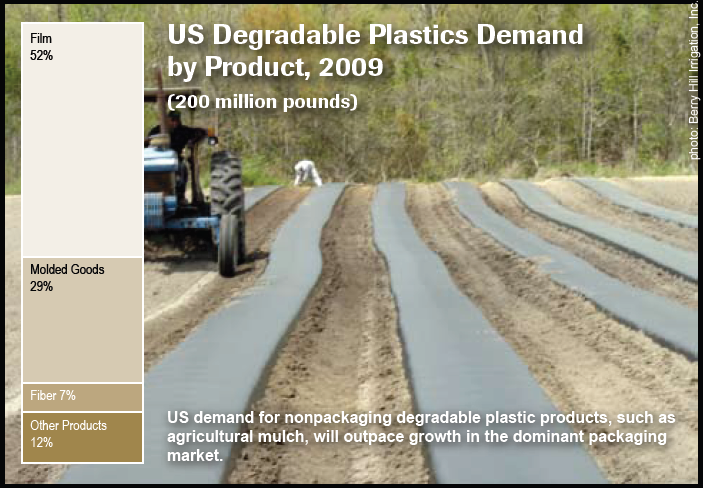
According to a new study from The Freedonia Group, demand for degradable plastics in the US is projected to rise nearly eleven percent annually to 335 million pounds in 2014, valued at $390 million.

Although representing less than one-half of one percent of all thermoplastic resin demand in 2009, degradable plastics will exhibit substantial growth opportunities. Degradable plastic advances will be fostered by their increased cost competitiveness with petroleum-based materials as well as their sustainability and more benign environmental profile.

Degradable plastics demand is being broadened by enhanced performance properties brought about by more sophisticated polymerization and blending techniques. Testing and certification standards have also been established for many types of biodegradable plastics, with growing pressures to limit packaging waste and expand the composting infrastructure.

Polylactic acid to be fastest growing degradable plastic

Polylactic acid (PLA) will grow at the fastest pace through 2014, driven by a more competitive price structure and greater availability. Myriad opportunities are expected, particularly in fiber applications such as nonwovens. Starchbased plastics will have a good outlook as a result of improved resin blends and applications in such areas as compostable yard and kitchen bags, as well as foodservice items such as plates, bowls and cutlery. Demand for polyhydroxyalkanoates (PHAs) will more than double, driven by an increase in the availability of PHA plastics and products. Opportunities are expected in areas such as films and molded containers. Slower growth is expected for photodegradable films such as ring carriers due to a maturing beverage container segment and competition from shrink film and paperboard packaging.

Nonpackaging products to outpace packaging market

Packaging, which accounted for nearly three-quarters of all degradable plastic in 2009, will exhibit good growth through 2014 in film and molded containers. However, most rapid growth is expected for nonpackaging products, particularly textile fibers in areas such as nonwovens, bedding and apparel. Other degradable nonpackaging products include compost bags, foodservice disposables and agricultural mulch.

mercredi 25 août 2010

Biodegradable and compostable food packaging overview

Shifting opinions on sustainability means that biodegradable and compostable plastics are no longer seen as destined to replace all traditional packaging – but are now viewed as one option among many, according to a new report by industry experts.

The review by Campden BRI said the sustainability rethink among sector players meant the materials were currently seen as one eco-alternative among many rather than an all encompassing solution to cutting packaging’s carbon footprint.

“There is little doubt that biodegradable and compostable plastics have become a reality, and their use seriously considered when selecting and designing packaging,” said the report. “However the way they are perceived has changed. A few years ago, it was perceived that biodegradable plastics were the only sustainable option and they would replace all conventional packaging.”

Sustainability is currently perceived in a different way, with biodegradable plastics viewed as one of many alternatives to achieve green goals, added authors D Cava and A Campbell in their study Biodegradable and compostable packaging material for foodstuffs.

Performance

The report said that concerns over the “sustainability, performance and viability of commercial biodegradable grades of polymer are disappearing”.

For some types of packaging they are used because of their degradability, when recycling is not feasible. They are also employed for their breathable characteristics for such products fruit and bakery products. The report added that most materials currently on the market are used in niche applications – such as in ranges of organic fruit and vegetables.

Material types

The study provides a detailed overview and analysis of the current biodegradable material types on offer. Biobased polymers are spearheaded by starch-based materials, with proteins, such as whey, collagen, gluten and zein also highlighted. A second type of materials is polyesters produced by natural or genetically modified organisms – such as polyhydroxyalkanoates (PHA). Biodegradable polymers obtained by synthesis – such as polylactic acid (PLA) – are also significant in the sector.

The report also outlines synthetic bio-options not obtained from renewable sources – such as polyvinyl alcohol (PVOH). Such polymers are produced from petrochemical feedstock and have been used in the medical sector for sometime. Recent demand for sustainable packaging has highlighted their potential for the food industry. While the report views these as a “not wholly sustainable alternative in the long term” they could be seen as a “compromise solution” while dependence on oil-based plastics remains.

Cost

The study noted that bioplastics were currently more expensive than petroleum-based counterparts and that substitution would lead to a rise in the cost of packaging. It added, however, many materials were at early-stage development and prices would likely fall as the technology was developed, making them more competitive.

Quoting figures from the European Bioplastics Association showing that production had leapt from 20,00 tons per annum (t/a) in 1995 to a predicted 1.5m t/a by the end of next year, the report said it could be concluded that “a momentum has been generated and that biodegradable and compostable materials are becoming more competitive”.

“It is now possible to source carbon neutral, biodegradable materials that are suitable for a wide range of applications at a competitive price,” said the report. It cited “several small businesses” that that are developing new materials. Should these be successfully scaled up, the availability of biodegradable materials and the range of applications they could be used for would both be increased.

Suppliers

In 2008, global output of biodegradable plastics reached around 300,000 tons. The report added that most of the industrial production of biodegradable packaging material is currently carried out by agriculture or biotechnology companies rather than those firms traditionally involved in the sector. This is because of the production processes applied, raw material used and final applications.

Development of new materials is generally a collaborative process between these companies and chemical of food packing firms – with the creation of a joint venture a “common feature”. The signing of distribution agreements between smaller outfits and larger companies is a further market characteristic.

Leading players include Natureworks - with a potential PLA capacity of 140,000 t/a - cited as the world’s largest biodegradable plastics producer. BASF – with its Ecoflex resin output targeted at 46,000 t/a by the end of this year, along with Cereplast, Novamont and Metabolix are also highlighted.


jeudi 12 août 2010

Bioplastics News: bio-feedstocks, compostable and biodegradable


While materials like polylactic acid currently get most of the attention, bioplastics experts believe that eventually the majority of bio-based resins will be conventional resins -- such as polyethylene and polypropylene -- made from renewable resources rather than from petroleum.

“The next generation of bio-plastic resins is already coming,” said Jim Lunt of Jim Lunt & Associates LLC in Wayzata, Minn. “There is increasing interest and development in making both existing and new monomers from renewable resources. We are transitioning from oil-based to renewable feedstocks.”


After Frito Lay's and Coca-Cola's move to use bioplastic, this news from Procter & Gamble (P&G) is another big boost to the bioplastic industry.

P&G said today that it will use sugarcane-based high-density polyethylene (HDPE) plastic made by Braskem into some of its packaging on its Pantene Pro-V, Covergirl and Max Factor brands. Pilot products will be rolled out globally over the next two years with first commercial products expected on the shelf in 2011.


Some ten years ago the packaging industry started to attract consumer’s attention for biodegradable plastics, and, although still in its infancy, biodegradable plastics continue to enjoy a growing interest with the public at large.

Compostability is not synonymous with biodegradability, a distinction that regulations make clear. But who knows?

While the industry is greenwashing its image in regard to the consumer, the same consumer is left with the fictional idea that he is helping to save the environment by buying products in so-called biodegradable, compostable, packages.

And in the meantime? Why use and promote biodegradable and compostable packaging material when it all ends up in landfills or incinerators. Increasing usage of biodegradable films is in conflict with ‘separation-at-source’ initiatives. Consumers are confused when it comes to separating biodegradable, compostable and recyclable plastics.

lundi 19 juillet 2010

Plastic packaging: threats and eco-friendly alternatives

Plastic Packaging (PE and PP) : shortages and rising prices

The British Plastics Federation has joined European colleagues to warn of the threat to the sector of raw material shortages and rising prices.

BPF director general Peter Davis said that while this situation was affecting the entire sector, packaging manufacturers were feeling it most due to the availability of polyethylene and polypropylene.

HDPE price increase

In the 12 months to May, the euro price of high-density polyethylene for blow-moulding rose by more than 30%, the BPF said.

Polypropylene rose by 50% for the same period.

The BPF said the situation was due to the faster than expected economic recovery and the surge in Chinese demand in particular.

Reduced European reduction

European plastics production is also set to reduce – cracker capacity in the EU is forecast to fall by 26% in the next five years. The trend is towards production in the Middle and Far East.

Peter Davis said: "It is extremely important that the end customer buying and using plastic products, whether food retailers or car manufacturers, realise the very real pressures that our processing members are under and reflect this sympathetically in negotiations with suppliers.


Paper or Plastic?

Conscientious consumers going about their busy days eating, working, shopping and cooking are faced with many little decisions that can have a cumulative impact on the environment or their health.

We like to believe we're making the best choices, but we often don't have the resources or time to really check it out.

The Tribune recently compiled a list of consumer dilemmas from readers and staff, then consulted the experts, crunched the numbers and considered different angles to come up with some answers.


Purac starts project to produce lactic acid from papermaking waste streams

Purac has signed a contract to participate in a consortium that will develop a process to produce feedstock from cellulosic waste derived from the pulp and paper industry. This feedstock is expected to be usable for production of lactic acid. The other partners in the program are Crown Van Gelder N.V., a paper producing company, and Bumaga B.V., a development center in the paper and board industry. The project is part of the Dutch Biorefinery program and partially funded by the Dutch Ministries of Economic Affairs and Agriculture, Nature and Food Quality.

jeudi 3 juin 2010

Bioplastics News: Growth and future Market


The bioplastics sector, consisting of plastics that either biodegrade or have bio-based components, surged last year despite the economic downturn, according to an industry press release.

European Bioplastics, which represents European manufacturers, released the results of a survey of its members asking what sort of growth they experienced last year and what their expectations are for 2011. According to the survey, 47 percent of companies saw an increase in sales, with only 10 percent seeing sales decline last year. Some companies saw sales growth of more than 5 percent last year. Two thirds of the companies surveyed plan to increase investment next year, and 60 percent expected good to excellent results in the coming year.

According to European Bioplastics, bioplastics are being used with increasing frequency in durable products, including cell phone housing and car parts. The organization cited increasing demand for climate protection and reduced consumption of fossil fuels as drivers for the industry.

Despite recent growth, however, bioplastics still represent only 1 percent of the plastics market. The organization called for increased incentives in order to grow the market beyond its niche.

The future of compostable packaging for QSRs

Quick-service restaurants with Seattle locations are well aware the city's "foam ban" goes fully into effect July 1. That means throw-away packaging can no longer be made of expanded polystyrene and must be either recyclable or compostable.

While more QSRs are weighing eco-friendly packaging options, moving to a compostable lineup means overcoming a number of hurdles, Elmore said. Most brands are deterred by the cost. Although prices have come down in recent years, compostable packaging still costs more than traditional packaging.
La société Vegetal & Mineral Water va démarrer dans les prochains jours sa production de bouteilles en PLA (acide polyactique), extrait de l’amidon de maïs non transgénique, à Bourbonne-les-Bains (Haute-Marne).
---
« Nous disposons de trois lignes de production, qui ont mobilisé un investissement de 1 million d’euros, dédiées respectivement aux eaux plates, aux eaux gazeuses et à diverses boissons. Par exemple nous sommes en contact avec des producteurs de jus de fruits bio », explique le dirigeant qui a élaboré ses bouteilles en bioplastique recyclable et intégralement compostables avec le concours du laboratoire d’étude des matériaux polymères d’emballage (LEMPE) de l’Université de Reims et de l’Ecole supérieure d’ingénieurs emballage et conditionnement (ESIEC), également à Reims.

Pour répondre aux contraintes (résistance à la pression et étanchéité) liées à l’embouteillage de boissons gazeuses, et renforcer l’effet barrière du PLA, l’entreprise utilise, alternativement ou simultanément, plusieurs process comme l’introduction de nanoparticules – notamment d’argile – ou le traitement plasma.

POLYSOLE: SOLEGEAR Bioplastics Inc.

After four years of intensive Research and Development, involving chemical engineers and scientists from around the world, SOLEGEAR Bioplastics Inc. is announcing the market readiness of POLYSOLE®.

POLYSOLE® is a 100% natural bioplastic that can biodegrade within weeks after disposal. While plastic bags, food packaging and cup liners are a huge step in the right direction, POLYSOLE® is an ENGINEERED, HIGH PERFORMANCE plastic designed for use in the automotive, electronics, pharmaceutical and consumer goods industries.
--