Affichage des articles dont le libellé est Design. Afficher tous les articles

mercredi 14 août 2013

Eco-Friendly Packaging: Designing Better with Less

Short-lived, sometimes bulky, packaging has been an integral part of our daily lives for many years now. And it hasn’t stopped changing! The agri-food industry, the largest user of packaging, is also the primary vector for innovation in the sector.

Packaging is not useless!

Often criticized and accused of being a source of contamination and pollution, we often forget that packaging serves many purposes. The main function of packaging is to preserve and protect the product as it moves down the chain, from producer to consumer by way of transportation and intermediate storage. It helps to prevent spoilage and damage, which would result in economic and ecological loss! Good packaging also helps to guarantee the health and safety of consumers. Packaging serves several other purposes, such as displaying information, marketing, and diversifying and presenting products in various portions.

Packaging and over packaging: the confusion

When we think of the environment and packaging, we inevitably think of waste. The problem often arises from over packaging, rather than the packaging itself. This problem is costly for manufacturers and is very annoying for consumers. In Québec, the adoption of new environmental standards, which come at the same time as regulations 102 and 130, may well bring on a new era in packaging design. That’s good news!

Eco-design: reconciling the environment with packaging

For all businesses in the agri-food sector, “producing better with less” is becoming an urgent matter. The solution may lie in eco-design, an innovative approach that focuses on prevention as a means of minimizing the impact of packaging on the environment throughout its life cycle. It involves reducing at the source, reusing and recycling, and promoting the use of renewable materials in the designing process. This approach is often advantageous for companies since, in most cases, it helps to increase profits, through increased sales and a reduction in production costs. It reinforces the brand image, demonstrating a true commitment to environmental responsibility, which is also an excellent way to set yourself apart from the competition.

mercredi 16 janvier 2013

ThermaFresh Box: RETHINKING fresh fish packing containers


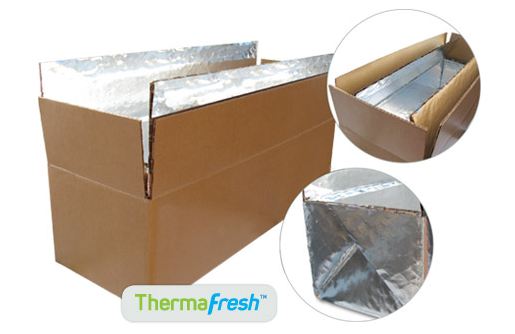
Cascades offers ThermaFresh, a new packaging innovation that is an ingenious eco-designed option to replace traditional fresh fish packing containers. By rethinking protective packaging, Cascades provides the industry with a high-performance, cost-effective solution for the packaging and distribution of fresh food.

The ThermaFresh container is designed for shipment of fresh food both inside and outside the cold chain, and its thermal performance is equivalent to that of the traditional containers. The containers can keep the food at the required chill level (39°F/4°C) outside the cold chain for a period exceeding 48 hours.

The components of the ThermaFresh container are a water-resistant corrugated box, a metalized film liner, and a honeycomb structural core. The thermal barrier uses the principle of radiant barrier technology. The Technicomb (honeycomb paperboard) construction traps the air inside, and the metalized film liner reflects the heat molecules; when both are combined, they provide significant thermal performance. Since the ThermaFresh container is Direct Food Contact compliant, no plastic bag is required for the shipment of whole fishes.

The smart, patented waterproof liner is crack-proof and the ThermaFresh container can resist rough handling. This considerably reduces spoilage and eliminates potential contamination which can occur through the distribution process.

With this new alternative container, there is no additional disposal cost to the end user. The ThermaFresh container is easily recyclable and it can be bailed within the OCC (Old Corrugated Container) programs. Thanks to ThermaFresh, rethinking fresh food distribution packaging provides the industry with the cost effective, added performance it needed.

Download Brochure
“We start with the perfect water, which produces beautifully textured fish, but the other important thing is the way we pack it up. We have a system [of recyclable corrugated cardboard cartons and liners] that makes sure that the chef gets to experience the fish exactly as it was pulled from the water, and then customers get a great dining experience”. Dave Mergle, Skuna Bay's marketing director.


Cascades has produced a video-animation exhibiting all of its eco-designed packaging innovations with respect to industrial uses, which is available on line at: Cascades Industrial Packaging

dimanche 16 décembre 2012

Landor’s 2013 trends forecast: Future of packaging


1)      Single-servings and on-the-go packaging


20 percent of meals in the United States are eaten in the car, so packaging structures are going to need to take advantage of that and be mobile, easy to handle in the car, and in portions for being on the go.
There's also been a huge explosion of snack bars, which are the ultimate portable food that you just throw in your pocket or your handbag.

There are also a lot more single and smaller households in the United States. Twenty-seven percent of households in this country are single-person households and packaging must address single-serving as well as easy-to-prepare meals for a person living alone.

2)      Sensory packaging


The second trend is about engaging consumers with your packaging in-store. With the advent of digital and online purchasing, I think people are just used to getting things in the mail, and the package is a secondary consideration. But when people are actually shopping in the store I think they want something that is more interesting and engaging.

Another sensory trend is tactility. There are a lot of printers doing new techniques with raised varnishes and sparkle varnishes and different elements that can provide a tactile experience when you interact with the package.

3)      Unique packaging and personalization


Another trend we’re seeing is a new level of originality and personalization. Absolut vodka actually just did the first package where they had to completely retool their production line so they could make every bottle absolutely unique. The line was called Absolut Unique, and every bottle is completely different—a different abstract painting on every bottle.

We're also seeing in packaging the ability to personalize your experience with the product.

4)      Sustainable packaging


The next continuing trend is green packaging. I think consumers are expecting green packaging more and more from the products that they’re buying, and they want to know about recycling and recycled quantity in the package.

We talked about stand-up, resealable pouches—the Tide Pod, for example. Capri Sun is now in a stand-up pouch. These are just more ecologically sound from a shipping standpoint. When they’re shipping the empty packages they take up a lot less space. Additionally, most of them are recyclable. I think consumers are responding to that; more and more products are in those packages.

5)      Bioresins


The next trend is bioresins. Nature Fusion from Pantene is using 30 percent bioresin in their bottles. The bioresin war was started between Coke and Pepsi. Coke was first out with plant bottles, but Pepsi was the first to come out with a 100 percent bioresin bottle. They are looking to get to a bioresin that is made more with waste materials from food processing so there won't be any farming or agricultural implications of growing the material to make the bottles. Additionally, I have heard that they're trying to make bottles out of chicken feathers!


mercredi 14 novembre 2012

5 Creative Packaging Ideas to Delight Your Customers


Small companies may lack the marketing dollars and visibility of larger brands, but they can still stand out on the shelf by thinking outside the box—literally. Here are five packaging design tips to help you get the attention of customers and even delight them.

1.     Go for a handmade look. Customers are drawn to packaging that feels personalized—it's almost as if they're holding a handmade object.

2.     Take a sustainable approach. Consumers want to feel good about their purchases. Using sustainable material, such as organic, fair-trade or recyclable paper, will send an environmentally positive message about your brand.

3.     Use surprising materials and shapes.  A distinctively shaped package or one made of nontraditional materials can signal to consumers that your product is different from the competition.

4.     Add in functionality. Customers like packaging that's functional because of its added value

5.     Let your package tell your product's story. Some companies think of creative, playful ways to give customers a clue to what's inside the package.

mercredi 24 octobre 2012

Paperboard Package of the Year


One-hundred and forty-three entries from 34 Paperboard Packaging Council (PPC) members were honored in a special awards ceremony at PPC's Fall Meeting and Leadership Conference on October 18, 2012 in Las Vegas, as part of the 69th annual North American Paperboard Packaging Competition.

This year, the top Paperboard Package of the Year award was presented to Graphic Packaging International (Marietta, GA) for their new package design for the 10-Count Capri Sun carton for Kraft Foods. The new fridge vendor-style design features "I-Beams," an extension of the carton's end flaps that are folded in toward the carton. The new design is 20% lighter than the original carton, saving approx. 35,000,000 pounds of fiber annually. Moreover, a 60% increase in inbound pallet quantities was achieved, resulting in approx. 1,750 trucks eliminated from the inbound supply chain, thus saving 880,000 miles driven annually. A 7% increase in outbound cases per pallet resulted in a 2.5% increase in finished goods on outbound trucks and a 10% reduction in tertiary pallet packaging materials.

To see the list of top winners click Here

mardi 18 septembre 2012

“Inflation masquée”: Moins dans l’emballage au même prix

L’industrie agro-alimentaire est fortement touchée par l’augmentation des prix des denrées alimentaires (sucre, farine et lait surtout), à laquelle s’ajoute l’augmentation du prix de l’emballage, lui-même, tiré à la hausse par l’explosion des cours du pétrole. 

Depuis toujours les manufacturiers doivent trouver la juste équation entre, d’une part le prix de leur produit, leurs profits, l’emballage et, d’autre part, les aléas du marché comme l’augmentation des prix de la matière première, et une compétition de plus en plus féroce. Pour rester concurrentiels et plutôt que d’opter pour une augmentation des prix de leurs produits, plusieurs marques ont trouvé une solution miracle : procéder à une belle cure d’amaigrissement de l’emballage et tant qu’à faire du contenu. Si la taille de l’emballage diminue, et si le contenu est réduit, le prix reste toutefois le même; c’est ce qu’on appelle le «Shrink Packaging». Le plus souvent, le consommateur ne s’en aperçoit pas car cela se dissimule derrière un nouveau design plus moderne et plus alléchant. 

Ce phénomène a toujours existé, mais les compagnies sont de plus en plus nombreuses à le pratiquer. Depuis l’automne 2008, on assiste à une recrudescence de cette pratique qui s’est largement accentuée en raison de la crise. Selon plusieurs études de marché, prés de 30% des biens emballés, et pas seulement des produits alimentaires seraient concernés par une réduction de taille (poids/volume).

Il est pourtant certain qu’il serait plus rentable pour les entreprises de communiquer sur ce « grignotage de contenu » et de l’expliquer au grand public, plutôt que de le passer en douce. Cela pourrait en effet affecter l’image de la marque. Le consommateur fidèle pourrait en effet se sentir berner et finir par bouder celle-ci. En la matière, comme dans d’autres domaines, la transparence a ses vertus. Par ailleurs, cela pourrait être l’occasion pour les manufacturiers de communiquer sur la dimension environnementale d’une telle démarche de « Shrinking ». En effet, la plupart du temps, réduire l’emballage à la source peut être l’occasion de diminuer grandement l’impact environnemental du produit.

mercredi 5 septembre 2012

Les prix GAIA: Le meilleur en emballage et mise en marché en alimentation


Ce concours exclusif est réservé à l'industrie agroalimentaire et a pour objectif de récompenser l'originalité et la créativité des manufacturiers et transformateurs agroalimentaires pour leurs efforts en termes de design graphique et conditionnement d'emballage dans la mise en marché de leurs produits.

De plus, le concours a pour mission de récompenser des entreprises qui font des efforts démarqués et qui commercialisent leurs produits dans des emballages faisant appel à l'utilisation de matières recyclables et/ou environnementales.

Le concours « LES PRIX GAÏA » est réservé exclusivement aux entreprises qui œuvrent dans et/ou pour l'industrie agroalimentaire et plus spécifiquement aux entreprises qui sont dans les catégories ci-dessous :

  • Les transformateurs agroalimentaires
  • Les manufacturiers agroalimentaires
  • Les designers graphiques indépendants
  • Les studios de design graphique
  • Les agences de publicité
  • Les fabricants et imprimeurs qui œuvrent dans l'industrie de l'emballage agroalimentaire


jeudi 16 août 2012

Innovative and creative Paper-based packaging design box: Chiah Ti Ti


Replicating the vintage sweet and crispy flavor, the product is named in “Chiah Ti Ti” which means “eat sweet” in Taiwanese. The meaning of the product also becomes the essence of symbol. Analyzing the font of the product packaging with the happy atmosphere, we find out an innocent and childlike smiling face is added among the calligraphy of playful vibe indicating good things can happen anytime, just like the brand name “Chiah Ti Ti” full of blessings and enjoyment.

Considering the retail price, the packaging adopts the reduction package of one-piece design that not only enables a wrapper to fold the box quickly, saving the cost of time and labor while packaging, but also decreases packaging expendables. To satisfy the requirements of 3 different flavors in this series, the packaging shares the same style of outer box but uses sticker of different colors and patterns to differentiate among 3 flavors. In addition to boarding the unity of this product series, enhancing consumers’ impression, the design of sharing the same packaging box also save unnecessary cost on materials, improving the function.


jeudi 21 juin 2012

Twelve principles of sustainable packaging


  1. Reduce/eliminate hazardous substances in the packaging materials
  2. Use raw material/feedstock of greener origin
  3.  Select packaging material based on its disposability
  4. Create a green design
  5. Modify/substitute existing packaging material or process
  6. Make packaging machines and systems energy efficient
  7. Reduce waste generated during processing, conversion, and packaging operations
  8. Apply green logistics
  9. Segregate and dispose of waste
  10. Optimize packaging economics
  11. Comply with regulations and create awareness among consumers
  12. Use sustainable packaging metrics and tools to evaluate sustainable packaging.

 Source 

vendredi 6 avril 2012

Sustainable Origami Food Box


This is a packaging for a quick service mobile eatery in Manila, Philippines called Guactruck. Inspired by origami, the packaging resembles a bud that blooms into a flower when opened. It was created with sustainability in mind, being only one piece of paperboard with no glue or plastic.


Source: Packaging of the World

mercredi 25 janvier 2012

Fully recyclable packaging – good green cred or unsustainable smokescreen?


Recyclable products are key to a sustainable business model but companies must go further to be considered truly green. Frances Cook looks at whether packaging companies hide behind a 'fully recyclable' slogan and asks, what must be done to create a more sustainable product life cycle?

All look and no substance?

Consumers' perceptions can be created by all manner of factors, but one of the greatest influencers in packaging is the design - the way the product looks and feels.

"Printing a recyclable device or message is very prevalent in most first world countries now but there are subtle differences and there is sometimes a tendency to play this up with brands from S-MEs more than multinationals" said Andrew Streeter of Pack-Track, a Datamonitor packaging research service and packaging expert.

"People are beginning to using words like fully recyclable and probably stretching the point. It is not used as a smokescreen as such, but more as a marketing claim - it is opportunistic," he added.

"There is a trend of sustainability and greenness which some companies are taking advantage of. I hold the view that packaging in some regions is taking on a consumer perceived 'greenish' persona. Matt inks have enjoyed a renaissance, surface texturing, plastics can look very paper like and there are more board applications.

"They are trying to fulfil a consumer need, that recyclable, green element in the brand values. Perhaps there is a hidden or more covert approach to this development, it also conveys a quality dynamic in the brand."


lundi 9 janvier 2012

Communication pour le développement durable: Emballage et suremballage


Suite au succès de la première rencontre annuelle de son Université d'hiver, le Conseil de la comdd prépare déjà pour les 16 et 17 février 2012, Les 48 heures de la communication pour le développement durable sur le thème Communication et marketing responsables.

Le concept de l’université d’hiver: la grande rencontre annuelle des communicateurs propose un cadre de dialogue et d'innovation pour les professionnels de la communication en collaboration avec des experts en environnement et en développement durable.

Je serai sur le panel thématique: Communication visuelle responsable pour échanger sur l’emballage et le suremballage:
Au lieu de parler de zéro emballage, il serait plus adéquat de parler de Lutte contre le suremballage; un phénomène qui coûte cher au fabricant et suscite des réactions du client. L'emballage est un bien nécessaire plutôt qu'un mal. Il joue un rôle majeur dans la protection et la conservation des aliments en garantissant la sécurité alimentaire. Il constitue aussi un atout majeur dans la réduction des pertes de produits périssables.
Au plaisir de vous rencontrer et d’échanger avec vous!

dimanche 8 janvier 2012

Nine steps to environmentally friendly packaging


Improving the sustainability (environmental friendliness) of packaging is a hot topic for packaging professionals. The packaging industry has seen sustainability progress from the latest buzzword to an everyday part of our vocabulary. Still, there is room for basic knowledge and guidance, especially for those companies lacking large packaging staffs or sustainability departments.

Nine steps to take when designing more environmentally friendly packaging :

1-     Identify your company’s goals and initiatives. It is important to understand what environmental impacts your company is most concerned with and design with those in mind. For example, is your company concerned about the amount or types of plastic they use? If so, then that should be taken into consideration when designing new packages.

2-     Identify the destination of the package. This knowledge helps the designer understand what end-of-life options (recycling, landfill, incineration) are available at the destination, which may affect how you design your package. In addition, knowing the destination allows you to account for fees associated with any environmental impacts pertaining to your package.

3-     Identify applicable regulations. Regulations should supersede all other considerations in package design and, therefore, need to be considered early in the process. It is important to understand whether regulatory requirements are consistent for all destinations. If not, can the package be tailored to each destination, or should it be designed to meet regulations in all destinations?

4-     Determine how a package will be shipped. In general, the most energy-efficient mode of shipping is preferable. However, the mode of shipping is often determined by business requirements (e.g., balancing cost challenges, reduced inventory/increased turnover, flexibility/customized features/delivery, suppliers’/customers’ locations, etc.) It is important to design packages consistent with the mode of shipping selected and, when possible, to choose the most energy efficient shipping option.

5-     Identify internal requirements; marketing, regulatory affairs, and/or other applicable departments that should be considered. Internal requirements take into account whether the environmentally responsible package is economically viable, whether it enhances the product’s image and acceptability, and whether it protects the product from physical, biological, or chemical harm, among other considerations.

6-     Identify and understand any applicable customer requirements. It is much more common for customers (mainly retailers) to have specific package design guidelines that must be followed. These guidelines often include packaging materials they will not accept, specific pallet requirements, etc. Your best source in your company for finding this information is your sales team or supply chain organization. In addition, often you can find information on a customer’s website.

7-     Raw material selection. Product manufacturers face many tradeoffs when choosing between raw materials. Choices should be made with the complete life cycle of the package in mind.

8-     Address the actual package design. If you followed steps one through seven, you should be armed with enough information to minimize the environmental impact of your package.

9-     Communicate what your package hopes to accomplish, what has been done, and why it is important. Educating the consumer and the retailer is important to ensure that everyone’s understanding of environmentally responsible packaging is improved.

By following these nine steps, you will improve on the environmental impact of your packaging. 

vendredi 6 janvier 2012

10 tips for sustainable package design


With the fundamentals of sustainable packaging in mind, following are some areas to consider when implementing changes to your packaging for improved environmental impact.

For nearly a decade, the biggest buzz in packaging has been the move toward sustainability, or “green” packaging. Driven by retailer requirements, public perception, economic pressures (petroleum, in particular), and government policies, sustainability impacts every aspect of a package—from the source of its raw materials to its end of life—and as such has proven to be an incredibly complex issue.

But over the years of debate and discovery, we have learned some core truths about the topic. First, there is no such thing today as a completely sustainable package. Instead, sustainability is a journey. The goal is to make incremental improvements over time in the sustainability of a package to reduce its overall environmental impact.
Second, in sustainability terms, packaging materials—including glass, plastic, paper, and aluminum—cannot be classified as good or bad. Each has its advantages and shortcomings, depending upon the product application and the goals and mission of the packager. Trade-offs are an inherent part of pursuing sustainability.

And last, packaging must be put into perspective by understanding its role in the full product supply chain. Packaging typically makes up less than 10% of the carbon footprint of a product; manufacturing and consumer use often comprise the largest proportion. While packaging’s footprint may be small, its importance cannot be understated. If the package fails in its primary functions—protecting the product through the supply chain, enticing consumers to purchase, and facilitating consumption—all the energy consumed in manufacturing the product is lost when the product is wasted.

Ten tips for sustainable packaging design With these fundamentals in mind, following are some areas to consider when implementing changes to your packaging for improved sustainability:

1. Take a life-cycle approach to package design. 
2. Evaluate each component of your package. 
3. Consider new alternatives for distribution packaging.
4. Look for opportunities to make your packaging reusable—where it makes sense. 
5. Consider changes in your product. 
6. Whenever possible, design for recyclability. 
7. Employ packaging strategies that encourage product consumption. 
8. Know where your packaging materials come from. 
9. Evaluate your distribution system for space-saving opportunities. 
10. Consider materials made from renewable feedstock. 


lundi 19 décembre 2011

A responsible supply chain is a delicate balancing act


In a recent conversation with a large client, I was very encouraged to learn that the responsible supply chain is becoming an integral part of product and packaging strategy for them and also for their competitors. Setting corporate sustainability goals around products and packaging, adhering to national and regional regulations, holding suppliers accountable to become more environmentally and socially conscious, have made it into boardroom discussions and corporate strategy.

Businesses are finally looking at sustainability in product lifecycles as new regulations are being formulated or enforced around the world.  Companies are also seeing growing consumer demand for green products. Responsible supply chains span every phase of a product’s lifecycle – design, manufacturing, packaging, transportation and disposal.

Below is a sample of questions businesses should ask of themselves to understand how to be more responsible:
  1. Design: How do we reduce the use of material (dematerialize) and impact to the environment (decarbonize)? Or have early considerations been given to make the product conducive to remanufacturing or recycling after its end of life?
  2. Manufacturing: What portion of the product is made out of renewable, recycled, or remanufactured material? How efficient are the manufacturing processes from material use, energy consumption, emission and waste generation viewpoints?
  3. Packaging: While ensuring that the functional requirements of packaging are not compromised, what proportion of the total material is reused, recycled and renewable?  Are there any banned non-recyclable material used in the packaging? What metrics are multi-brand retail customers such as Wal-Mart and Tesco using to rank and manage the sustainability performance of their suppliers are you prepared to adhere to such customer scorecards.
  4. Transportation: Are you considering the impact that shipping has on the environment? Have you considered optimal vehicle design to improve fuel efficiency? What clean fuel sourcing strategy do you have in place or are considering? Have you enforced truck idling reduction policies or made investments in optimizing route planning?

Managing and maintaining an optimal harmony among what goes as input to the supply chain, what is made and how much goes as waste is critical to responsible supply chain and to good product stewardship. In my next blog I will write about life after the end of life of a product and how it can be a powerful solution to reducing waste and curtailing pollution.