You find enclosed my talk entitled: "Sustainability & Functionality at the Heart of Packaging Innovation" given at the Greener Packaging Awards, November 18, 2013 in Brussels, Belgium.
Affichage des articles dont le libellé est Packaging. Afficher tous les articles
Affichage des articles dont le libellé est Packaging. Afficher tous les articles
lundi 18 novembre 2013

mercredi 14 août 2013
Eco-Friendly Packaging: Designing Better with Less

Short-lived,
sometimes bulky, packaging has been an integral part of our daily lives for
many years now. And it hasn’t stopped changing! The agri-food industry, the
largest user of packaging, is also the primary vector for innovation in the
sector.
Packaging is not useless!
Often
criticized and accused of being a source of contamination and pollution, we
often forget that packaging serves many purposes. The main function of
packaging is to preserve and protect the product as it moves down the chain,
from producer to consumer by way of transportation and intermediate storage. It
helps to prevent spoilage and damage, which would result in economic and
ecological loss! Good packaging also helps to guarantee the health and safety
of consumers. Packaging serves several other purposes, such as displaying
information, marketing, and diversifying and presenting products in various
portions.
Packaging and over packaging: the confusion
When we think of the
environment and packaging, we inevitably think of waste. The problem often
arises from over packaging, rather than the packaging itself. This problem is
costly for manufacturers and is very annoying for consumers. In Québec, the
adoption of new environmental standards, which come at the same time as
regulations 102 and 130, may
well bring on a new era in packaging design. That’s good news!
Eco-design: reconciling the environment with
packaging
For all businesses in
the agri-food sector, “producing better with less” is becoming an urgent
matter. The solution may lie in eco-design, an innovative approach that focuses
on prevention as a means of minimizing the impact of packaging on the environment
throughout its life cycle. It involves reducing at the source, reusing and
recycling, and promoting the use of renewable materials in the designing
process. This approach is often advantageous for companies since, in most
cases, it helps to increase profits, through increased sales and a reduction in
production costs. It reinforces the brand image, demonstrating a true
commitment to environmental responsibility, which is also an excellent way to
set yourself apart from the competition.
lundi 5 août 2013
Cool new packaging helps consumers with common frustrations
We’ve all been there—fighting to get a package open. Or trying to get the last drop out of a bottle. When you consider that manufacturers spend more than $150 billion a year on packaging, you might wonder why more products aren’t user-friendly. Consumer Reports has some good news! Here is some innovative packaging that’s solved some problems. (Source)
mercredi 10 juillet 2013
Bright future for Reusable Plastic Containers (RPC)?

According
to a study initiated by the Stiftung Initiative Mehrweg (SIM) -a German
foundation for reusable systems- carried out by Fraunhofer Institute and the
University of Bonn, throughout the whole supply chain for fresh fruit and
vegetables from the producer to the retail, around 4 percent of all disposable
packaging was damaged, while this figure was just 0.1 percent for reusable
packaging.
In
the course of the study, more than 78,000 packaging units for transport were
inspected at central warehouses and retailers, including 52 percent reusable
and 48 percent single trip.
The
study determined that if only reusable containers were used in the German
market, only 1,100 tonnes of fruit and vegetables valued at two million Euro
would have been lost. It was estimated that if only single trip packaging had
been used, the lost product would translate to 36,000 tonnes valued at 68
million Euro.
Extrapolating
from these figures to the Spanish global exports of fresh fruits and
vegetables, more than 1,800 million euros could be saved when using just
reusable crates and containers.
The European
Commission estimates that approximately 89 million tonnes of food are wasted
every year in Europe, with Germany on top of the ranking, with 10.7 million
tonnes of wastage and Spain in sixth place, with 7.7 million. Although most of
the wastage happens at the end of the food supply chain (retailers and
consumers), there are also losses in the production and distribution chain,
which is the one under scrutiny in this report.

The UK's leading fresh fruit and vegetable
supplier to the restaurant and catering industry has implemented a reusable
transit packaging (RTP) crate scheme with Schoeller Allibert, to reduce waste
and keep produce fresh. Reynolds estimates that, as a result, over the last
year it has sent out 750,000 fewer cardboard and wooden boxes to customers and
saved hundreds of tonnes of cardboard and paper.
Reynolds took the decision to move away from single trip cardboard packaging to a returnable crate scheme with Schoeller Allibert. So far, over 1,000 customers have switched to deliveries with the Maxinest crates, which have an average lifetime Product Carbon Footprint of just 26 kgCO2e for each crate, 68% less than cardboard.
Reynolds took the decision to move away from single trip cardboard packaging to a returnable crate scheme with Schoeller Allibert. So far, over 1,000 customers have switched to deliveries with the Maxinest crates, which have an average lifetime Product Carbon Footprint of just 26 kgCO2e for each crate, 68% less than cardboard.

Over
recent months the company has seen added interest from fish merchants,
suppliers and processors who are looking to purchase from PPS East various
reusable containers, including plastic boxes, pans, defrosting crates and
pallets for internal factory use. For storage and transportation of product to
customers, orders are being placed for fish fillet trays, salmon and whole fish
boxes, bale-arm crates, baskets, tubs and bins.
Traditionally,
PPS East has supplied boxes for the Humber fish auction markets and also rents
reusable plastic packaging for fresh fish suppliers in the UK and Europe. The
company says that since the recent launch of its direct sales division revenue
has increased and as a result, PPS East is now stocking at it Grimsby site a
comprehensive range of fish box sizes (6kg, 10kg, 15kg, 25kg, 40kg & 50kg)
for direct sales to customers. The company can also source most types of
plastic containers as required, along with plastic pallets, wheeled dollies,
insulated bins, pallet boxes, dolavs, etc

IFCO
SYSTEMS, the global leader in Reusable Plastic Containers (RPCs) for fresh
products, today released a study confirming RPCs as a sustainable packaging
option. The report shows the IFCO solution generates 82% less solid waste,
consumes 92% less water, requires 49% lower energy demand, and lowers ozone
depletion by 76% for a weighted average of 10 top produce commodities compared
with shipping the same amount of produce in display-ready corrugated boxes. The
report was produced by Franklin Associates, a Division of ERG, a leading
consulting company specializing in life cycle analyses and solid waste
management.

Last summer (June 2012), Safeway has transitioned to using reusable
product containers (RPCs), rather than corrugated boxes, to ship many types of
produce from the farm fields, through the distribution channel and to final store
destination. This transition eliminated the use of over 17 million pounds of
corrugated boxes, , reduced CO2 by 37,518 tonnes, avoided harvest of 114,000
trees.
dimanche 21 avril 2013
A Global Flexible Packaging Market SWOT statement to 2016

Another remarkable
article from the Converting Curmudgeon. Mark Spaulding is sharing with us UK-based PCI
Films Consulting president Simon King SWOT statement from
his keynote presentation on the“Global Flexible Packaging Market”.
Strengths
- The global flexible packaging
market (at $71 billion in 2011) will grow by around 5.0% a year, reaching
$90 billion in 2016. North America and Central/East Asia will be the top
two regional markets with 25% and 24% shares, respectively.
- Flexible packaging is an
industry relatively immune from global economic downturns.
- In 2016, 42% of the industry
will be in Asian markets, which are growing at about 7% a year — the
fastest growing region is Southeast Asia and Oceania, driven by high
demand in India with 15-20% annual increases.
- The global arena remains
“local” with regional converters supplying the vast proportion of local
packaged-goods customers’ needs. Only 4% of flex-pack production is traded
outside the region in which it is manufactured.
- Amcor, Bemis and Sealed Air are
the top three product converters with 9%, 8% and 4% global market share,
respectively.
- Flex packs’ inherent
source-reduction characteristics (thin materials, lighter weight) allow
packaging-waste reduction over rigid formats.
Weaknesses
- Flexs packs have a reputation
for being hard to recycle — especially multilayer laminated structures
that are often not accepted in curbside recycling programs.
- Higher raw-material costs and
lack of suitable barrier properties of biodegradables and compostables
mean that so far these materials have had little impact.
- Economic uncertainty has
encouraged only short-term buying, just-in-time delivery by customers in some
regional markets.
- Western Europe (and to a lesser
extent, North America) is suffering from low value growth (1-2% a year)
compared to other regions. Volumes are being sustained primarily by
serving only defensive end-use markets.
- Mature flex-pack markets in
Oceania (Australia, New Zealand, Singapore) are growing only 1-2% a year.
Opportunities
- Global personal disposable
incomes are rising, encouraging consumers to buy more packaged goods of all
types.
- Standup pouches, the dominant
format in Western Europe, are a vanguard of positive environmental and
consumer-convenience trends for flex packs.
- High oxygen- and
moisture-barrier, metallized laminates and coextrusions are likely
to extend the value-added sector.
- Multinational brand owners are
sourcing globally, driving inter-regional M&As among converters, or
converters adopting strategies for a global presence.
- Investment in new plants,
equipment in places such as Russia, India, Indonesia is boosting
lower-cost, more-efficient production.
- Converters need to establish
lower-cost production in countries where access to cost-conscious markets
is free (Mexico, Poland).
- Promotion and possible
investment in breakthrough pyrolysis systems are needed to boost this
important new flexible-packaging recycling process for laminates and
aluminum-foil structures.
Threats
- Flex-pack converters must
address environmental issues to cut packaging waste, promote growth in
lighter weight products as cost-effective alternatives to rigid packaging.
- Sustainability has now become
just as important as the above traits.
- Legislative pressures may force
adoption of non-oil-based materials.
- For North America, low-cost
imports from Asia are increasing, especially onto the US West Coast.
Converters with Mexican plants are exploiting the low-cost base to
competitively supply into the US. And growth in imports of pre-packaged
products into the US from Mexico translates into reduced demand for
US-made flexible packaging.
mercredi 23 janvier 2013
Results of Recyclable Produce Box Pilots
For the pilots, Global Green USA teamed up with members of their Coalition for Resource Recovery (CoRR) to test alternatives to paraffin-coated produce boxes, which cannot be recycled and are a contaminant within bales of uncoated cardboard. Boxes were tested with a variety of wet cooling processes in California and New Jersey and the results show that many box products with recyclable coatings are robust enough to withstand vacuum cooling, hydro-vac, and hydro-cooling processes.
"The move to recyclable-coated boxes will divert waste from landfills and save money for the foodservice and retail industry," says Lily Kelly, interim director of CoRR and coordinator of the pilots. "It is an exciting time."
Greens, vegetables, seafood, and meats are often transported in paraffin-coated cardboard, generating 1.45 million tons of solid waste that must be sent to landfills or burned. If these cases were designed for recycling and were recycled, CoRR believes retailers and restaurants could realize a net benefit of combined cost savings and revenue generation of $200 million nationwide. CoRR has worked since 2008 to accelerate the industry adoption of alternative recyclable-coated packaging and recycling it, which could reduce America's annual carbon emissions by 4.5 million mtCO2e—the equivalent of eliminating an entire coal-fired power plant with no loss of energy. (The Fibre Box Association estimates that 5% of OCC is wax-coated. EPA’s 2010 Solid Waste Facts and Figures, WARM Tool, and Greenhouse Gas Equivalencies Calculator were used to calculate potential greenhouse gas savings. Savings assumes 100% of the boxes and packaging generated is recycled. National restaurateur and grocers’ savings are based on a national average tipping fee of $44.09, based on the 2010 data in BioCycle’s State of Garbage report. A spot market price of $100/ton of OCC was assumed.)
Food producers report finding recyclable boxes easier to use than paraffin-coated boxes, and have benefited from being able to recycle them on the farm. “This is good news for farmers and our customers," says Vince Consalo of Consalo and Sons, a produce distributor in Vineland, NJ, who helped to test the recyclable boxes in September. “Recyclability is a big selling point." Other participants in the pilot program also expressed satisfaction with the results, including Lakeside Organic Gardens in Watsonville, CA.
The results are advantageous for grocers, who may soon be receiving more recyclable-coated boxes that they can bundle with their regular cardboard instead of paying to send them out with the trash. "Selling cardboard is a revenue stream for us, and it helps contribute to our Zero Waste Goals of 2020," says Dom D'Agostino of Ahold Intl., which operates several grocery store chains, including Stop and Shop and Giant. "If we could recycle coated cardboard, it would significantly help us meet these goals."
Global Green USA's pilot series is slated to continue in 2013. "As a third party, our job is to document these tests and spread the word about what is recyclable and what works,” says Kelly. "Our next steps are to document increasingly tough use of the boxes—wetter cooling and longer distance traveled. We’re confident that these boxes can handle it, and we’re excited to document next year's story in video as well."
mercredi 16 janvier 2013
ThermaFresh Box: RETHINKING fresh fish packing containers
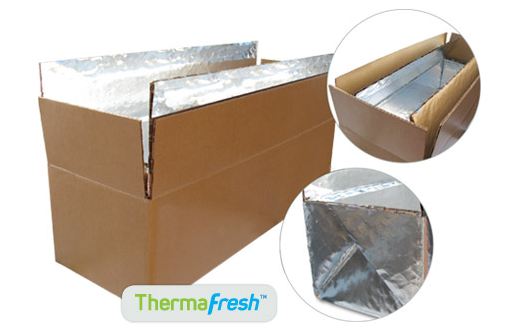
Cascades offers ThermaFresh, a new packaging innovation that is an
ingenious eco-designed option to replace traditional fresh fish packing
containers. By rethinking protective packaging, Cascades provides the industry
with a high-performance, cost-effective solution for the packaging and
distribution of fresh food.
The ThermaFresh container is designed for shipment
of fresh food both inside and outside the cold chain, and its thermal
performance is equivalent to that of the traditional containers. The containers
can keep the food at the required chill level (39°F /4°C ) outside the cold chain for
a period exceeding 48 hours.
The components
of the ThermaFresh container are a water-resistant
corrugated box, a metalized film liner, and a honeycomb structural core. The
thermal barrier uses the principle of radiant barrier technology. The Technicomb
(honeycomb paperboard) construction traps the air inside, and the metalized
film liner reflects the heat molecules; when both are combined, they provide
significant thermal performance. Since the ThermaFresh container is Direct Food Contact compliant, no plastic bag is
required for the shipment of whole fishes.
 The smart,
patented waterproof liner is crack-proof and the ThermaFresh container can resist rough handling. This considerably
reduces spoilage and eliminates potential contamination which can occur through
the distribution process.
The smart,
patented waterproof liner is crack-proof and the ThermaFresh container can resist rough handling. This considerably
reduces spoilage and eliminates potential contamination which can occur through
the distribution process.
With this
new alternative container, there is no additional disposal cost to the end
user. The ThermaFresh container is
easily recyclable and it can be bailed within the OCC (Old Corrugated
Container) programs. Thanks to ThermaFresh,
rethinking fresh food distribution packaging provides the industry with the
cost effective, added performance it needed.
Download Brochure
“We start with the perfect water, which produces beautifully textured fish, but the other important thing is the way we pack it up. We have a system [of recyclable corrugated cardboard cartons and liners] that makes sure that the chef gets to experience the fish exactly as it was pulled from the water, and then customers get a great dining experience”. Dave Mergle, Skuna Bay's marketing director.
Source: Skuna Bay Salmon
Cascades has produced a video-animation exhibiting all of its eco-designed packaging innovations with respect to industrial uses, which is available on line at: Cascades Industrial Packaging
dimanche 16 décembre 2012
Landor’s 2013 trends forecast: Future of packaging
1)
Single-servings and on-the-go packaging
20 percent of meals
in the United States are eaten in the car, so packaging structures are going to
need to take advantage of that and be mobile, easy to handle in the car, and in
portions for being on the go.
There's
also been a huge explosion of snack bars, which are the ultimate portable food
that you just throw in your pocket or your handbag.

There are also a lot
more single and smaller households in the United States. Twenty-seven percent
of households in this country are single-person households and packaging must
address single-serving as well as easy-to-prepare meals for a person living alone.
2)
Sensory packaging
The second trend is
about engaging consumers with your packaging in-store. With the advent of
digital and online purchasing, I think people are just used to getting things
in the mail, and the package is a secondary consideration. But when people are
actually shopping in the store I think they want something that is more
interesting and engaging.
Another sensory trend
is tactility. There are a lot of printers doing new techniques with raised
varnishes and sparkle varnishes and different elements that can provide a
tactile experience when you interact with the package.
3) Unique packaging and
personalization
Another trend we’re
seeing is a new level of originality and personalization. Absolut vodka
actually just did the first package where they had to completely retool their
production line so they could make every bottle absolutely unique. The line was
called Absolut Unique, and every bottle is completely different—a different
abstract painting on every bottle.
We're also seeing in
packaging the ability to personalize your experience with the product.
4)
Sustainable packaging
The next continuing
trend is green packaging. I think consumers are expecting green packaging more
and more from the products that they’re buying, and they want to know about
recycling and recycled quantity in the package.
We talked about
stand-up, resealable pouches—the Tide Pod, for example. Capri Sun is now in a
stand-up pouch. These are just more ecologically sound from a shipping
standpoint. When they’re shipping the empty packages they take up a lot less
space. Additionally, most of them are recyclable. I think consumers are
responding to that; more and more products are in those packages.
5) Bioresins
The next trend is
bioresins. Nature Fusion from Pantene is using 30 percent bioresin in their
bottles. The bioresin war was started between Coke and Pepsi. Coke was first
out with plant bottles, but Pepsi was the first to come out with a 100 percent
bioresin bottle. They are looking to get to a bioresin that is made more with
waste materials from food processing so there won't be any farming or
agricultural implications of growing the material to make the bottles.
Additionally, I have heard that they're trying to make bottles out of chicken
feathers!
jeudi 29 novembre 2012
How2Recycle Label: Making recycling make sense
Variation in recycling programs, unclear
labeling, and inaccurate recyclability claims make proper recycling a
challenge. The How2Recycle Label was created to provide consistent and
transparent on-package recycling information to consumers. Currently the label
only applies to packaging sold in the U.S.

The
Sustainable Packaging Coalition (SPC), a project of sustainability nonprofit
GreenBlue, is pleased to announce additional participants in the soft launch of
its pioneering How2Recycle on-package recycling labeling system.
Major brand names,
including Best Buy, Clorox and Minute Maid, will be joining 10 other leading
companies already participating in the soft launch, including Costco Wholesale,
General Mills, Seventh Generation, and REI, in implementing the label on select
packaging available nationwide in early 2013. Additionally, the SPC has
announced its five-year plan for the labeling system.
How2Recycle was developed to reduce consumer confusion around recycling in the
United States with a clear and consistent recycling label and corresponding
informational website, how2recycle.info. It provides companies with an easy way
to conform to the Federal Trade Commission's (FTC) "Green Guides"
while using nationwide recyclability data. While several other recycling labels
and symbols exist, the How2Recycle Label is the only one that communicates
recyclability across all material types and gives explicit directions to
consumers to influence their recycling behavior. It also specifies when a
package component is not recyclable.
dimanche 25 novembre 2012
Packaging gotchas: Mad at hard-to-open, shrinking, undersized, or overwrapped products?
You’d
think that companies would get it right. They spend $130 billion a year on
boxes, bags, and blister packs. You spend on packaging, too. According to Joe
Angel, vice president and publisher of the trade publication Packaging World,
packaging accounts for roughly 7 percent of a product’s overall cost, and some
of that gets passed along to consumers.
Yet
illogical, misleading, and over-the-top packaging continues to annoy consumers,
and we have the letters, e-mail, and photos to prove it. The annoyances come in
four basic types.
- Oysters, our term for hard-to-open products. Often, they’re gadgets imprisoned in clear, tight-fitting plastic. That displays merchandise from all angles and discourages theft. But it also foils honest folks, who have tried razor blades, scissors, box cutters, and saws to free the contents they’ve bought. Other oysters: cereals in stiff bags that split and spew their contents when you pry them open and pills in blister packs that give you a headache even as you’re trying to treat your ulcer.
- Black holes, or products surrounded by lots of air. Federal law is supposed to prevent excessive “slack fill,” nonfunctional or empty space. But there are loopholes in the law if, for instance, the space limits breakage or discourages theft, or if the package does double-duty as a dispenser. One company we were about to criticize actually changed its packaging after buyers complained. Archway modified the tray design for its Original Windmill Cookies “to accommodate a more tightly packaged product,” a spokesman told us.
- Downsized products, shrunken by companies unwilling just to raise the price. Downsizing can occur in sneaky ways, as when Huggies reduced the number of PullUps diapers from 72 to 70 but kept the words “New Larger” on the label. Companies usually blame downsizing on higher costs of ingredients, labor, and energy.
- Golden cocoons, tiny doodads shipped in giant cartons, sometimes with enough paper, bubble wrap, or airbags (called “void fill” in the packaging industry) to cradle a priceless vase. At least some companies are aware of the problem. (Read “Frustration-Free Packaging May Be Baffling,” below.)
Here
you'll find a showcase of our latest examples of packaging faux pas, submitted
by Consumer Reports readers and Facebook fans. For each product, we asked a
company rep to explain the packaging decision. Usually we received an answer,
though not always to the question we asked.
mercredi 14 novembre 2012
5 Creative Packaging Ideas to Delight Your Customers

Small companies may
lack the marketing dollars and visibility of larger brands, but they can still
stand out on the shelf by thinking outside the box—literally. Here are five
packaging design tips to help you get the attention of customers and even
delight them.
1.
Go for a handmade
look. Customers
are drawn to packaging that feels personalized—it's almost as if they're
holding a handmade object.
2.
Take a sustainable
approach. Consumers want to feel good about their
purchases. Using sustainable material, such as organic, fair-trade or
recyclable paper, will send an environmentally positive message about your
brand.
3.
Use surprising
materials and shapes. A distinctively shaped package or one
made of nontraditional materials can signal to consumers that your product is
different from the competition.
4.
Add in functionality. Customers like
packaging that's functional because of its added value
5.
Let your package tell your product's
story. Some companies think of creative, playful
ways to give customers a clue to what's inside the package.
dimanche 4 novembre 2012
2012 Survey of Future Packaging Trends

Packaging World magazine partnered with DuPont to
identify trends shaping the packaging industry today and in 10 years. Responses
reflect the insights of nearly 500 industry professionals predominantly in
Europe and North America working for consumer goods manufacturers and
converters in marketing and packaging development roles. Food, healthcare and
beverage markets ranked the highest, but nearly every industry that uses
packaging was represented.
 There was significant alignment in the views of
respondents in Europe and North America and throughout the results, the top
trends identified as driving today, are predicted to change in 10 years. Trends in the second tier tend to maintain
the same level of importance.
There was significant alignment in the views of
respondents in Europe and North America and throughout the results, the top
trends identified as driving today, are predicted to change in 10 years. Trends in the second tier tend to maintain
the same level of importance.
Key
Findings:
Poised on
the brink of change:
- Sustainability
concerns, ranked behind cost and food safety/security as today’s driving
trends, will dominate packaging industry work in 10 years in both Europe
and North America.
- Cost, today’s
top driver, drops in importance in 10 years.
- Food
safety/security remains a top factor driving packaging work.
- Today’s emphasis
on “right-sizing” gives way to strategies to use renewable materials,
recyclable materials and smart
packaging in 10 years – a clear call for innovation and collaboration
throughout the value chain.
- Though rarely
selected as a “top” trend, convenience factors are identified as very
important today – and that importance
is expected to be maintained in 10 years.
Maximum
value. Minimal Impact:
- The packaging
industry believes consumers will have increased value for recyclability
and perceived
- “greenness” of
packaging in 10 years – at the same time, demand for proof of sustainability
claims will grow exponentially, for
instance in the demand for life cycle analysis data.
- Right-sizing
packaging in terms of efficient package shape/size, downgauging of package
material and minimizing package failures dominate both the North American
and European packaging landscape today.
- Materials play a
critical role in these objectives.
- Plastics will
continue to replace glass and metals and flexible packaging will continue
to replace rigid structures.
mercredi 24 octobre 2012
Paperboard Package of the Year
One-hundred and forty-three entries from
34 Paperboard Packaging Council (PPC) members were honored in a special awards
ceremony at PPC's Fall Meeting and Leadership Conference on October 18, 2012 in
Las Vegas, as part of the 69th annual North American Paperboard Packaging
Competition.

This year, the top Paperboard Package of
the Year award was presented to Graphic Packaging International (Marietta, GA)
for their new package design for the 10-Count Capri Sun carton for Kraft Foods.
The new fridge vendor-style design features "I-Beams," an extension
of the carton's end flaps that are folded in toward the carton. The new design
is 20% lighter than the original carton, saving approx. 35,000,000 pounds of
fiber annually. Moreover, a 60% increase in inbound pallet quantities was
achieved, resulting in approx. 1,750 trucks eliminated from the inbound supply
chain, thus saving 880,000 miles driven annually. A 7% increase in outbound
cases per pallet resulted in a 2.5% increase in finished goods on outbound
trucks and a 10% reduction in tertiary pallet packaging materials.
To see the list of top winners click Here
samedi 4 août 2012
Coffeebrewer: Innovative and smart paper-based bag
Danish Coffeebrewer Nordic has created a disposable French press called the Coffeebrewer that works right inside its own bag.

 The Coffeebrewer is basically a hybrid between a filter dripmaker and a French Press. The design of The Coffeebrewer enables a perfect extraction as the volume of the pouch allows the hot water to interact with the coffee grounds and extract the aroma. The filter is designed to preserve all natural oils and flavours in the coffee.
mercredi 11 juillet 2012
Discover the Hidden value of Packaging
New brochure explains
how the thoughtful use of packaging actually helps prevent waste and save
energy. Sections focus on economic, environmental, and social benefits.
The
brochure is available free for download on the
AMERIPEN site.

vendredi 6 juillet 2012
US bioplastics demand to exceed 550M lbs in 2016
US demand
for bioplastics is forecast to climb at a 20 percent annual pace through 2016
to 550 million pounds, valued at $680 million.
Although they have achieved a considerable degree of commercial success,
bioplastics remain in an early stage of development, representing only a small
niche within the overall plastics industry. Going forward, technical
innovations that enhance the properties of bioplastics and lower their price
will drive growth. These and other trends are presented in Bioplastics, a
new study from The Freedonia Group, Inc.,
a Cleveland-based industry market research firm.

Although
biodegradable resins accounted for the vast majority of bioplastics volume in
2011, the emergence of non-biodegradable bioresins will dramatically alter the
market landscape going forward.
By 2021, these materials will represent more than two-fifths of volume demand,
up from 13 percent in 2011. Growth will be propelled by large-volume
production of bio-based polyethylene, as well as the eventual commercialization
of bio-based polyethylene terephthalate (PET), polypropylene, and polyvinyl
chloride (PVC). Since these resins are chemically identical to their
conventional counterparts, market acceptance is forecast to occur at a rapid
rate. Among these bio-based plastics, PET is projected to offer significant
growth potential over the longer term, particularly as large corporations --
especially those in the soft drink industry -- are investing heavily in the
development of this material.
Polylactic
acid (PLA) is expected to remain the most extensively used resin in the
bioplastics market through the forecast period, despite
issues regarding the inability of biodegradable products such as PLA to
decompose in landfills and their potential to contaminate the recycling
stream. Advances will be promoted by a widening composting network and
greater processor familiarity, as well as ongoing efforts to diversify PLA
feedstocks, as critics cite the food versus fuel debate and the energy- and
pesticide-intensive nature of corn production as a key drawback of biopolymers.
Bio-based
polyethylene -- which entered the market in 2010 -- is expected to offer the
best opportunities for growth through 2016, increasing rapidly from a small
base. These exceptionally strong gains are predicated on the
expansion of production capacity, which will reduce prices and enable this
resin to compete more effectively with its petroleum-based counterpart.
Inscription à :
Articles (Atom)