dimanche 31 mars 2013

Why Some Companies Successfully Innovate and Others Don't


The recession is over. But its end did not herald a return to business as usual. High rates of new product failure—once considered an inevitable cost of doing business—are now unacceptable. Today's thinner revenue streams, narrower margins, heightened competition, and more limited resources have, if anything, increased the already high levels of stress among corporate survivors and raised the performance bar set by business executives. That has prompted changes in the ways companies invest, manage, and innovate—changes designed to minimize risk.

Among the good management habits of innovative, high-performance companies:

Balance. Investments in breakthrough advancements were offset with spending on incremental innovations. While the rewards of home-run products are potentially very high, their associated risks are even higher. Winning companies don't bet all their chips on blue-sky projects.

Prioritize. Focus on product development projects that align with both market needs and the company's overall business strategy. Struggling to satisfy customer desires is only beneficial when it advances your company's longer-range objectives.

Analyze. Overcome the largest risk in product innovation—products that customers won't buy—by analyzing customer feedback quickly to ensure delivery of products the market is actually asking for. If a product idea is going to fail, or meet only 80 percent of customer expectations, it is a huge advantage to find that out as soon as possible, drop the idea, and move on to other, more appealing projects.

Automate. Top performers delivered products on time by using technology to manage requirements, administer workflow, and prioritize development. Too many companies rely on slower, less reliable manual processes.
There was also a flip side to the study's findings: challenges that consistently elude companies that are still struggling. Chief among them:

Not listening. Failure to hear and consider the expressed needs of customers. Those diverse voices must be considered, reconciled, and balanced to develop a truly successful product.

Not collaborating. Failing to share information and collaborate with customers, partners, suppliers, and other key stakeholders in exploring new ideas. For struggling companies, fewer than half their product ideas came from these sources.

Misalignment. Too often senior management and product-line staff fail to communicate, which often results in their spending time and money on the wrong product priorities.

Uncertainty. The lack of clear decision-making and confusion over product-line ownership leads to decisions based on internal politics, subjectivity, personal influence, and debate skills rather than product merits.

Paperwork. Paper-based methods and other traditional innovation management processes slow down the development life cycle, especially for complex products.

Poor execution. Struggling companies have trouble planning the resources needed to match market opportunities, difficulty managing multiple teams and regions, and a hard time managing the risks associated with new and existing products.

dimanche 17 mars 2013

Greening Fast Food Packaging


Dogwood Alliance’s report “Greening Fast Food Packaging: A Roadmap to Best Practices,” outlines eight key attributes of environmentally friendly fast food packaging, and provides guidance on how to assess environmental impacts in the supply chain. The report highlights leaders in the fast food industry. It also includes a survey to help assess a company’s current packaging.
  1. Embrace Corporate Leadership on Sustainability
  2. Use Full Life Cycle and Supply Chain Approach
  3. Reduce Overall Packaging and Increase Efficiency
  4. Increase the Use of Recycled Fiber
  5. Eliminate Paper Originating from Controversial Forestry Practices
  6. Increase In-Store Recycling and Recovery
  7. Eliminate Toxic Inks, Coatings and Labels
  8. Reduce Carbon Footprint

The full report is available at DogwoodAlliance

mardi 5 mars 2013

Cascades – Industrial Packaging, to exhibit at the 2013 International Boston Seafood Show

The International BostonSeafood Show is North America’s largest seafood trade show, which is taking place on March 10-12, 2013 at the Boston Convention and Exhibition Center.

Visit Cascades-IndustrialPackaging Booth #1180 to meet our friendly staff and learn more about our eco-friendly and innovative packaging solutions for the transport of fresh and frozen fish and seafood products.


lundi 4 mars 2013

Du Marketing Vert au Marketing Eco-responsable


Je vous invite à lire mon article publié dans le dernier numéro de la revue l’Actualité Alimentaire: Du Marketing Vert au Marketing Eco-responsable.

On pourrait penser  que "Vendre vert" aujourd'hui est plus facile que jamais. La preuve : tout le monde marketing semble avoir succombé à cette tendance. Surfer sur la vague verte n'est pourtant pas gage de ventes accrues, de nouvelles parts de marché ou de gains en termes d'images et de "branding".

Depuis plus de deux décennies, l’idée du développement durable s’est largement imposée. C’est tout naturellement que le marketing s’est emparé de nouveaux slogans apparus dans le sillage de ce concept phare répondant à l’intérêt grandissant d’un nombre croissant de citoyens-consommateurs pour la question environnementale. Cependant, le marketing vert n’a pas toujours su résister aux sirènes du « greenwashing ». Ce phénomène appelé aussi éco-blanchiment ou mascarade écologique, est le fait de tromper les consommateurs à propos des pratiques environnementales d’une entreprise ou des avantages environnementaux d’un produit ou d’un service.

Le marketing vert a trop longtemps reposé sur de simples prétentions non démontrées, jouant d’images confuses, voire trompeuses. Autrefois, option de facilité, le « greenwashing » se révèle être une ornière  dont il faut absolument sortir.  Plus que jamais, clarifier les messages du marketing vert est une priorité. L’heure est à l’humilité, au réalisme et à l’authenticité pour les entreprises qui entendent mettre en avant leurs bonnes pratiques environnementales ou mettre en marché des produits véritablement plus respectueux de l’environnement


Nb: N'hésitez pas à me contacter (pak-bec@hotmail.com) si vous voulez consulter l'intégrale de cet article.

mardi 26 février 2013

Smart Packaging: Food Safety Enhancement, Shelf-life Extension and Food Waste Reduction


I will be presenting at the upcoming SIALCanada 2013, scheduled for April 30 to May 2, 2013 in Toronto, Canada.  

My talk entitled: " Smart Packaging: Food Safety Enhancement, Shelf-life Extension and Food Waste Reduction " will be focused on the applications of smart packaging in food industry.

Abstract

There is a growing need to address the most pressing issues facing food supply, namely food safety, food waste and food access. Innovative packaging solutions could play a key role.

The focus of smart (active and intelligent) packaging has moved from specific retailer and manufacturer driven benefits like shelf-life extension, traceability and food waste reduction, to include more consumer focused benefits such as food quality and safety, freshness and information. Active and intelligent packaging is the results of “thinking outside the box.” They are based on a deliberate interaction of the packaging with the food and/or its direct environment.

Outline

  1. Food supply hot issues: Food Safety, Food Waste and Food Access
  2. Packaging’s vital role
  3. Active and intelligent Packaging: Concept, Applications & Innovations
  4. Take home

mercredi 13 février 2013

M&S Using Water-Saving Packaging to Transport Flowers


Retailer Marks and Spencer is using modified atmosphere packaging, which uses less water, to transport thousands of flowers over Valentine’s Day. The company, which already uses the special packaging to transport fruits and vegetables, said it will save 10,000 litres of water on Valentine’s Day by using this technology to deliver its £22 bouquets of Fairtrade red roses, reported the Daily Mail.

Finlays Horticulture has used MAP bags to transport flowers to M&S customers since 2011, according to M&S. Once a bag is sealed, oxygen levels in the bag decrease and carbon dioxide levels increase naturally. The change in atmosphere reduces the respiration rate of the flowers, which extends storage time and reduces the need for water, said M&S.

The MAP packaging has been designed to be airtight, which takes up less space and weight in delivery trucks, saving on fuel.

mercredi 23 janvier 2013

Results of Recyclable Produce Box Pilots

For the pilots, Global Green USA teamed up with members of their Coalition for Resource Recovery (CoRR) to test alternatives to paraffin-coated produce boxes, which cannot be recycled and are a contaminant within bales of uncoated cardboard. Boxes were tested with a variety of wet cooling processes in California and New Jersey and the results show that many box products with recyclable coatings are robust enough to withstand vacuum cooling, hydro-vac, and hydro-cooling processes.


 "The move to recyclable-coated boxes will divert waste from landfills and save money for the foodservice and retail industry," says Lily Kelly, interim director of CoRR and coordinator of the pilots. "It is an exciting time." 

Greens, vegetables, seafood, and meats are often transported in paraffin-coated cardboard, generating 1.45 million tons of solid waste that must be sent to landfills or burned. If these cases were designed for recycling and were recycled, CoRR believes retailers and restaurants could realize a net benefit of combined cost savings and revenue generation of $200 million nationwide. CoRR has worked since 2008 to accelerate the industry adoption of alternative recyclable-coated packaging and recycling it, which could reduce America's annual carbon emissions by 4.5 million mtCO2e—the equivalent of eliminating an entire coal-fired power plant with no loss of energy. (The Fibre Box Association estimates that 5% of OCC is wax-coated. EPA’s 2010 Solid Waste Facts and Figures, WARM Tool, and Greenhouse Gas Equivalencies Calculator were used to calculate potential greenhouse gas savings. Savings assumes 100% of the boxes and packaging generated is recycled. National restaurateur and grocers’ savings are based on a national average tipping fee of $44.09, based on the 2010 data in BioCycle’s State of Garbage report. A spot market price of $100/ton of OCC was assumed.) 

Food producers report finding recyclable boxes easier to use than paraffin-coated boxes, and have benefited from being able to recycle them on the farm. “This is good news for farmers and our customers," says Vince Consalo of Consalo and Sons, a produce distributor in Vineland, NJ, who helped to test the recyclable boxes in September. “Recyclability is a big selling point." Other participants in the pilot program also expressed satisfaction with the results, including Lakeside Organic Gardens in Watsonville, CA. 

The results are advantageous for grocers, who may soon be receiving more recyclable-coated boxes that they can bundle with their regular cardboard instead of paying to send them out with the trash. "Selling cardboard is a revenue stream for us, and it helps contribute to our Zero Waste Goals of 2020," says Dom D'Agostino of Ahold Intl., which operates several grocery store chains, including Stop and Shop and Giant. "If we could recycle coated cardboard, it would significantly help us meet these goals." 

Global Green USA's pilot series is slated to continue in 2013. "As a third party, our job is to document these tests and spread the word about what is recyclable and what works,” says Kelly. "Our next steps are to document increasingly tough use of the boxes—wetter cooling and longer distance traveled. We’re confident that these boxes can handle it, and we’re excited to document next year's story in video as well." 

vendredi 18 janvier 2013

The new, reusable (and recyclable) Starbucks® cup: Clarifications, Thoughts and Questions


I would like to share with you some Clarifications/Thoughts/Interrogations regarding the new, reusable (and recyclable) Starbucks® cup for hot beverages (source).

1-     "When I talked with Jim Hanna, director of environmental impact for Starbucks, regarding the cups made out of 100% virgin polypropylene, he told me that one main reason the company turned to plastic was to cut down on paper waste. Starbucks uses about 4 billion disposable cups annually and the interior wax coating makes them difficult to recycle." MISLEADING: Starbucks disposable cups are made from paper coated with PE (polyethylene). Polycoated cups are recyclable and repulpable. Furthermore, most paper mills are able to process paper mixed with other materials such as polycoated paper. Pulper equipped with scavenger could remove plastic debris. Finally, polyethylene coating represents less than 6.6% of total basis weight.

2-     "The exciting thing about PP is that it's one of the most versatile resins out there," Hanna said. "From cradle-to-cradle, PP offers one of the best environmental stories; it's just a winner all around." MISLEADING: Starbucks reusable cups are made from polypropylene #5 Plastics. In fact, most polypropylene #5 plastics, unless they're reused, end up in the landfill since so few municipalities accept them.

3-     What is the carbon footprint of reusable cup VS disposable cup?

4-     PP based reusable cups cost $1. However, a major price hike has hit the North American polypropylene market, sending prices up an average of 15 cents per pound since Jan. 1. Can we expect a cup price increase in the upcoming months?

5-     How about increasing Starbucks cups recycled fiber content? Cascades, developed recently a new grade of cupstock paper with 25% recycled fiber content.

6-     How about water-based coating for a fully repulpable and recyclable cups? (The idea is to replace Polyethylene by water-based coating)

7-     How long do the cups last? Reusable cups need a lot of carefulness/attention/love: not lose them, not crush them, and not forget to bring them…

mercredi 16 janvier 2013

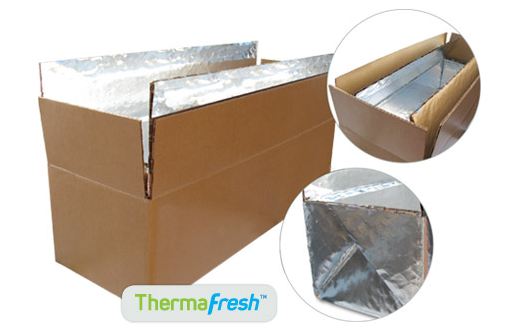
ThermaFresh Box: RETHINKING fresh fish packing containers


Cascades offers ThermaFresh, a new packaging innovation that is an ingenious eco-designed option to replace traditional fresh fish packing containers. By rethinking protective packaging, Cascades provides the industry with a high-performance, cost-effective solution for the packaging and distribution of fresh food.

The ThermaFresh container is designed for shipment of fresh food both inside and outside the cold chain, and its thermal performance is equivalent to that of the traditional containers. The containers can keep the food at the required chill level (39°F/4°C) outside the cold chain for a period exceeding 48 hours.

The components of the ThermaFresh container are a water-resistant corrugated box, a metalized film liner, and a honeycomb structural core. The thermal barrier uses the principle of radiant barrier technology. The Technicomb (honeycomb paperboard) construction traps the air inside, and the metalized film liner reflects the heat molecules; when both are combined, they provide significant thermal performance. Since the ThermaFresh container is Direct Food Contact compliant, no plastic bag is required for the shipment of whole fishes.

The smart, patented waterproof liner is crack-proof and the ThermaFresh container can resist rough handling. This considerably reduces spoilage and eliminates potential contamination which can occur through the distribution process.

With this new alternative container, there is no additional disposal cost to the end user. The ThermaFresh container is easily recyclable and it can be bailed within the OCC (Old Corrugated Container) programs. Thanks to ThermaFresh, rethinking fresh food distribution packaging provides the industry with the cost effective, added performance it needed.

Download Brochure
“We start with the perfect water, which produces beautifully textured fish, but the other important thing is the way we pack it up. We have a system [of recyclable corrugated cardboard cartons and liners] that makes sure that the chef gets to experience the fish exactly as it was pulled from the water, and then customers get a great dining experience”. Dave Mergle, Skuna Bay's marketing director.


Cascades has produced a video-animation exhibiting all of its eco-designed packaging innovations with respect to industrial uses, which is available on line at: Cascades Industrial Packaging