mardi 7 septembre 2010

Intelligent shelf life indicator could slash food waste

A new intelligent technology that gives a running countdown of a product’s shelf life by analysing time and temperature data could replace traditional ‘use by’ dates on food labels, said the Norwegian company spearheading the development.

TimeTemp said its innovative shelf life indicator is able to more precisely measure the freshness of food items as they pass through the supply chain from factory to consumer and could lead to a significant reduction in the amount of waste produce.

The firm said processors have little control over the temperatures their goods are exposed to throughout the value chain. Consequently, they often mark their products with a shorter shelf life as a precautionary measure which can mean a lot of edible food is thrown away. Norwegian food retailers discard over 50,000 tonnes of food annually, said TimeTemp.

Intelligent technology

Driven by the need to address these issues, the company has developed the innovative device, which is a small self-adhesive label attached to food products. It contains a range of non-toxic chemicals which react and change colour according to time and temperature. The chemical reaction is activated at the packaging line of the food producer and follows each item from production to consumer. The reaction shows the time left before expiration of that product in accordance with the actual degradation of the food item – which is illustrated and in an easy-to-read graphical format, said TimeTemp.

The firm said the intelligent packaging technology is applicable for all products where quality and lifespan depend on time and temperature variables during storage, as well as items where quality depends on maturity and ageing. Items such as meat, poultry, dairy and even bakery products would potentially benefit from using the technology.

“The existing practice of setting expiration dates on foods or other temperature sensitive products – such as ‘best before’, ‘use by’ and ‘display until’ - is just a presumption of a product’s actual life span,” TimeTemp general manager Christian Aasland told FoodProductionDaily.com. “To set such a date, one needs to guess what temperature the product will be exposed to throughout the cold chains. Because such average assumptions never will be correct for an individual product, a large portion of the food we was because of bad dates are perfectly fine.”

Actual storage conditions

He added the technology provides a more accurate indication of quality and therefore expiration because it is based on the actual storage conditions each individual product is exposed to rather than a general estimate made at the processing plant.

“The idea is to dynamically indicate date of expiration according to the true time and temperature each product experience in its life span,” he said.

The company has produced a prototype of the device and e hopes to bring a finished product to market sometime in 2011. It is currently working with grocery chain NorgesGruppen, baked goods supplier Lantmännen Unibake, and McDonald’s Norway.


vendredi 3 septembre 2010

Don't judge a cookie by its packaging

Six out of 10 candies, baked goods and breads at the grocery store overstated things such as "sugar free," "low in fat" or "100 per cent whole wheat" to convince shoppers to indulge in a treat or pay a premium, newly released government inspection test results show.


mercredi 1 septembre 2010

Degradable Plastics: US demand to rise nearly 11% annually through 2014

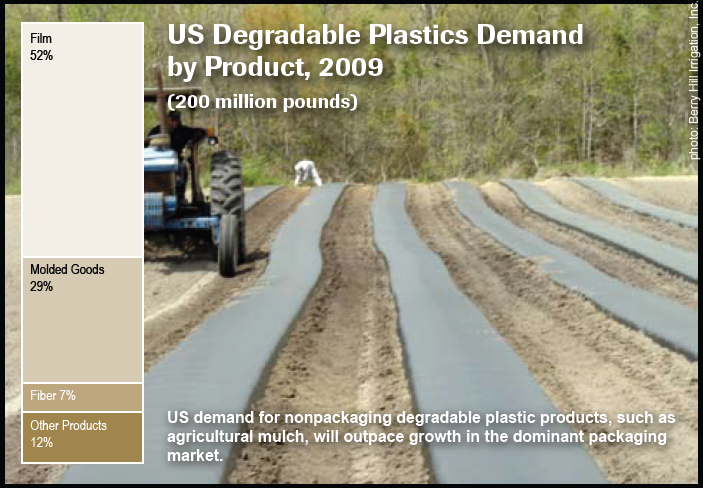
According to a new study from The Freedonia Group, demand for degradable plastics in the US is projected to rise nearly eleven percent annually to 335 million pounds in 2014, valued at $390 million.

Although representing less than one-half of one percent of all thermoplastic resin demand in 2009, degradable plastics will exhibit substantial growth opportunities. Degradable plastic advances will be fostered by their increased cost competitiveness with petroleum-based materials as well as their sustainability and more benign environmental profile.

Degradable plastics demand is being broadened by enhanced performance properties brought about by more sophisticated polymerization and blending techniques. Testing and certification standards have also been established for many types of biodegradable plastics, with growing pressures to limit packaging waste and expand the composting infrastructure.

Polylactic acid to be fastest growing degradable plastic

Polylactic acid (PLA) will grow at the fastest pace through 2014, driven by a more competitive price structure and greater availability. Myriad opportunities are expected, particularly in fiber applications such as nonwovens. Starchbased plastics will have a good outlook as a result of improved resin blends and applications in such areas as compostable yard and kitchen bags, as well as foodservice items such as plates, bowls and cutlery. Demand for polyhydroxyalkanoates (PHAs) will more than double, driven by an increase in the availability of PHA plastics and products. Opportunities are expected in areas such as films and molded containers. Slower growth is expected for photodegradable films such as ring carriers due to a maturing beverage container segment and competition from shrink film and paperboard packaging.

Nonpackaging products to outpace packaging market

Packaging, which accounted for nearly three-quarters of all degradable plastic in 2009, will exhibit good growth through 2014 in film and molded containers. However, most rapid growth is expected for nonpackaging products, particularly textile fibers in areas such as nonwovens, bedding and apparel. Other degradable nonpackaging products include compost bags, foodservice disposables and agricultural mulch.

dimanche 29 août 2010

Frito Lay et Naya : les limites de l’éco-conception

Explosion façon geyser à l’ouverture des nouvelles d’eau Naya composée de 100% de plastique recyclé post-consommation; bruissement insoutenable du paquet 100% compostable de chips Frito Lay…les emballages éco-conçus n’auraient-ils pas certaines limites que les industriels ne devraient pas sous-estimés ?

L’éco-conception présente, certes des vertus incontestables. Il s’agit d’une démarche novatrice et préventive, qui vise à minimiser l’impact de ces derniers sur l’environnement tout au long de leur cycle de vie: 1) Privilégier la réduction à la source, 2) Encourager la réutilisation et le recyclage, 3) Promouvoir la mise au point de matériaux renouvelables. Cette démarche est fréquemment profitable pour l'entreprise. Elle contribue à augmenter ses profits soit par une augmentation des ventes, soit par une réduction des coûts de production.

Cependant, l’éco-conception ne doit pas faire oublier les fonctionnalités et attentes de tout emballage : Conservation, protection transport et…Praticité. Cette dernière semble justement avoir été sous-estimée par les nouveaux convertis à l’éco-conception.

Par praticité, on entend la facilité d’ouverture et le confort d’utilisation. Deux éléments qui semblent avoir été négligés par Naya et Frito Lay. Ils ont péché par excès de marketing vert.

Frito Lay et Naya promettent de remédier à ces deux désagréments. De nos jours, trouver le compromis entre suremballage, sous-emballage, durabilité et praticité est un objectif ambitieux mais incontournable pour tout industriel.

Vous pouvez consulter ici le dossier consacré à l’éco-conception des emballages


Optimum Packaging: The Innventia AB model shows that the environmental consequences of product losses caused by excessive packaging reduction are far greater than guaranteeing adequate protection through an incremental excess of packaging

mercredi 25 août 2010

Biodegradable and compostable food packaging overview

Shifting opinions on sustainability means that biodegradable and compostable plastics are no longer seen as destined to replace all traditional packaging – but are now viewed as one option among many, according to a new report by industry experts.

The review by Campden BRI said the sustainability rethink among sector players meant the materials were currently seen as one eco-alternative among many rather than an all encompassing solution to cutting packaging’s carbon footprint.

“There is little doubt that biodegradable and compostable plastics have become a reality, and their use seriously considered when selecting and designing packaging,” said the report. “However the way they are perceived has changed. A few years ago, it was perceived that biodegradable plastics were the only sustainable option and they would replace all conventional packaging.”

Sustainability is currently perceived in a different way, with biodegradable plastics viewed as one of many alternatives to achieve green goals, added authors D Cava and A Campbell in their study Biodegradable and compostable packaging material for foodstuffs.

Performance

The report said that concerns over the “sustainability, performance and viability of commercial biodegradable grades of polymer are disappearing”.

For some types of packaging they are used because of their degradability, when recycling is not feasible. They are also employed for their breathable characteristics for such products fruit and bakery products. The report added that most materials currently on the market are used in niche applications – such as in ranges of organic fruit and vegetables.

Material types

The study provides a detailed overview and analysis of the current biodegradable material types on offer. Biobased polymers are spearheaded by starch-based materials, with proteins, such as whey, collagen, gluten and zein also highlighted. A second type of materials is polyesters produced by natural or genetically modified organisms – such as polyhydroxyalkanoates (PHA). Biodegradable polymers obtained by synthesis – such as polylactic acid (PLA) – are also significant in the sector.

The report also outlines synthetic bio-options not obtained from renewable sources – such as polyvinyl alcohol (PVOH). Such polymers are produced from petrochemical feedstock and have been used in the medical sector for sometime. Recent demand for sustainable packaging has highlighted their potential for the food industry. While the report views these as a “not wholly sustainable alternative in the long term” they could be seen as a “compromise solution” while dependence on oil-based plastics remains.

Cost

The study noted that bioplastics were currently more expensive than petroleum-based counterparts and that substitution would lead to a rise in the cost of packaging. It added, however, many materials were at early-stage development and prices would likely fall as the technology was developed, making them more competitive.

Quoting figures from the European Bioplastics Association showing that production had leapt from 20,00 tons per annum (t/a) in 1995 to a predicted 1.5m t/a by the end of next year, the report said it could be concluded that “a momentum has been generated and that biodegradable and compostable materials are becoming more competitive”.

“It is now possible to source carbon neutral, biodegradable materials that are suitable for a wide range of applications at a competitive price,” said the report. It cited “several small businesses” that that are developing new materials. Should these be successfully scaled up, the availability of biodegradable materials and the range of applications they could be used for would both be increased.

Suppliers

In 2008, global output of biodegradable plastics reached around 300,000 tons. The report added that most of the industrial production of biodegradable packaging material is currently carried out by agriculture or biotechnology companies rather than those firms traditionally involved in the sector. This is because of the production processes applied, raw material used and final applications.

Development of new materials is generally a collaborative process between these companies and chemical of food packing firms – with the creation of a joint venture a “common feature”. The signing of distribution agreements between smaller outfits and larger companies is a further market characteristic.

Leading players include Natureworks - with a potential PLA capacity of 140,000 t/a - cited as the world’s largest biodegradable plastics producer. BASF – with its Ecoflex resin output targeted at 46,000 t/a by the end of this year, along with Cereplast, Novamont and Metabolix are also highlighted.


vendredi 20 août 2010

'Compostable' plastics pose problem for recyclers, composters

Composting at home can be a messy business. To help keep the process clean, or just to have the convenience of a plastic bag without its environmental impact, many people use compostable or biodegradable bags.

“Anything in a landfill, whether it’s biodegradable, or compostable, certified or not, won’t break down,”. “It’s not a controlled environment. So even something like an apple can take decades to decompose.” Marika Smith, executive director of the Compost Education Centre.

A key element of compost is heat, and home composting methods don’t get hot enough to break down bags meant for a commercial composting facility, Smith says. Consumers should read the package to see if they are buying an item meant for a home or a commercial compost, she says.

Even in a commercial composting facility, not everything will break down. Consumers who use a such a service should look for products made with the ASTM D6400, BPI or EN13432 standard, says Jason Adams, owner of reFUSE, a composting collection and recycling company. These bags break down well at its commercial composting facility. Other products without such certifications may not live up to the hype.

Biodegradable and compostable plastics are causing a problem for recyclers. If mixed with traditional soft-plastic recycling, these plastics may contaminate the lot, which means bags that typically would be recycled are being thrown out.

“A lot people go out and buy these products, thinking that they’re doing good, but if all of this stuff is going into the garbage — or if you haven’t checked if the bag can be used in a home compost — it’s not doing much good, and it’s possibly costing you more,”

Read full Vancouver Sun article

mercredi 18 août 2010

Le sac SunChips de Frito Lay: Un emballage bruyant et non compostable…

Le gros buzz "croustillant" s’avère finalement bruyant et non compostable


Bouteilles de plastique : l'enfouissement parfois une meilleure solution que le recyclage ?

Via le blog Echo-Responsable

Selon une récente étude d’une firme californienne, SRI Consulting, envoyer les bouteilles de plastiques en PET (polyethylene terephthalate) dans les sites d’enfouissement serait, dans certains pays, une solution générant moins de dioxyde de carbone que le recyclage.

Cela serait plus particulièrement vrai des pays où l’enfouissement connaît peu de contraintes en termes d’espaces et où les infrastructures de recyclage sont limitées, ce qui se trouve être notamment le cas pour le Canada et certaines régions des États-Unis.

Dans ce rapport décidément polémique intitulé "PET’s Carbon Footprint: To Recycle or Not To Recycle", une autre conclusion interpelle. On y lit que le transport des bouteilles de plastique par voie maritime vers la Chine ou d’autres destinations lointaines ne ferait pas augmenter de façon très importante l’ensemble de leur empreinte carbone en comparaison avec d’autres étapes de leur cycle de vie. Cela signifierait que contrairement à ce que l’on pense communément ces transports sur longue distance ne seraient pas source d’une aussi grande pollution que cela.

Le rapport souligne enfin que l’incinération serait la pire des options en termes de GES dans la mesure où le carbone que contient les bouteilles est directement rejeté dans l’atmosphère.

Que dire des conclusions de cette étude ? Peut-on véritablement se satisfaire de l’enfouissement comme solution en se fondant sur l’émission de carbone comme critère? Détourner du recyclage et expédier à l’enfouissement les bouteilles en PET ne consiste t-il pas à encourager une perte de matière alors qu’on peut et qu’on sait la valoriser?

En tout état de cause, il faudrait rappeler que la meilleure des options demeure de respecter, chaque fois que cela est possible, le 1er R du fameux triptyque : Réduire, Réutiliser et Recycler. En l’occurrence, cela signifie réduire notamment sa consommation d’eau embouteillée et privilégier l’eau du robinet, au besoin se munir d’une carafe filtrante et investir dans une gourde… Vous me direz à ce moment-là, il vaut mieux éviter celles qui pourraient contenir Bisphénol A ;) Mais cela peut se faire sans pour autant tomber dans la paranoïa et le dogmatisme écolo, car c’est tout simplement une habitude simple et facile à prendre…

lundi 16 août 2010

Bisphénol A: la substance est présente chez 9 Canadiens sur 10

Neuf Canadiens sur dix ont dans leur organisme du bisphénol A (BPA), un produit chimique industriel utilisé dans les emballages alimentaires et pouvant agir comme un perturbateur hormonal, selon un rapport du ministère de la Santé rendu public lundi.

La présence du BPA dans l'urine est la plus forte chez les adolescents âgés de 12 à 19 ans et la plus faible chez les personnes de plus de 60 ans, selon les résultats d'une enquête de Statistique Canada ayant porté sur 5.600 volontaires entre 2007 et 2009 et destinée à mesurer la présence de plus de 80 contaminants dans leur corps.

"Santé Canada, rappelle le rapport, a fait une évaluation scientifique préalable de l'impact de l'exposition des humains et de l'environnement au BPA et a conclu que cette substance est nuisible pour la santé humaine et l'environnement" selon les critères édictés dans une loi de 1999 sur la protection de l'environnement.

Les catégories à risque à protéger en priorité sont les nouveau-nés et les bébés et c'est ainsi que le Canada a interdit en mars dernier la vente des biberons en polycarbonate contenant du bisphénol A.

Cependant, indique le rapport, "Santé Canada a conclu que l'exposition actuelle au BPA provenant des matériaux d'emballage des aliments ne pose pas de risque pour la santé de la population en général, y compris pour la santé des nouveau-nés et des nourrissons".

La dose journalière admissible au Canada est de 25 microgrammes par kilogramme de poids corporel.

Or, la moyenne de concentration de bisphénol A chez les Canadiens s'est établie à 1,16 microgramme par litre d'urine.

Le bisphénol A se comportant comme un oestrogène et donc risquant d'affecter le système hormonal, il est soupçonné d'augmenter les risques de puberté précoce chez les femmes, de cancer de la prostate ou du sein et d'anomalies de reproduction. De tels effets ont été observés chez des rongeurs de laboratoire.

Mais de nombreuses études commandées par les industriels qui l'utilisent massivement comme additif dans le plastique de type polycarbonate pour bouteilles d'eau et revêtement de canettes, tendent à démontrer que ces craintes ne sont pas scientifiquement fondées chez l'homme.